Showing posts with label Auto. Show all posts

2.12.2015

The Evolution of Automotive Suppliers

Gao Feng Insights Paper, February 2015


Industry observers tend to overlook the changing role and structure of the automotive supply base. Of course, the story of success in the market is often viewed through the retail sales volume of branded OEM products. However, over the course of several decades, automakers have grown increasingly reliant on an ever smaller number of large tier 1 suppliers to deliver the core technology and innovation needed in the marketplace.
As a result, automakers face new challenges to maintain a balance of power with this new breed of supplier. In addition, suppliers at all tier levels must establish a position of relevance in a supply chain dominated by such power players. And finally, tier 1 suppliers must continue to anticipate the trends and development in the marketplace and upgrade their portfolio of capabilities in order to press their advantage.
In this analysis, we describe the trends, highlight several case examples, and discuss the implications of these developments along four strategic themes.
Thought leadership is core to what Gao Feng does.  We will, from time to time, share with you our latest thinking on business and management, especially as it relates to China and China’s role in the world.
Bill Russo
Managing Director, Gao Feng Advisory Company
bill.russo@gaofengadv.com
Chee-Kiang Lim
Principal, Gao Feng Advisory Company
ck.lim@gaofengadv.com
Tel: +86 10 8557 0676 (Beijing); +852 2588 3554 (Hong Kong); +86 21 5117 5853 (Shanghai)
Gao Feng website: www.gaofengadv.com

1.28.2015

Toyota Isn't in Tune With China's Needs: Russo

Bloomberg Television, January 22, 2015

Gao Feng's Managing Director Bill Russo discusses China's car market snd why the country is so important for automakers with Bloomberg's Rishat Salamat on "On The Move".


http://www.bloomberg.com/news/videos/2015-01-22/toyota-isn-t-in-tune-with-china-s-needs-russo

1.17.2015

China in 2025 and Implications for Automakers

Gao Feng Insights Report, January, 2015

Dear Friends of Gao Feng, 
  
We are pleased to share with you a report titled: China in 2025 and Implications for Automakers.  As we know, China’s economy has been growing dramatically for more than two decades.  China is now the second largest (and will inevitably soon become the largest) economy in the world.  Yet we are recently confronted with rising concern over the impact of a deceleration in overall economic growth, especially in the automotive sector.

Since 2011, we have seen single digit growth in 3 of the past 4 years, raising questions over the future prospects for the industry.  In this analysis, we seek to avoid the trap of “driving by looking in the rear-view mirror”, and instead look in front of us at the plausible scenarios which may unfold which will impact the auto industry over the next decade.

We believe that China’s economic growth is likely to continue over the next decade, driven by a mix of continued (albeit more selective) fixed-asset investment and growth in consumption.  A broad transformation is expected to continue and will present an environment that is characterized by a long-term and sustained shift towards a middle-income, consumption-based economy.  This trend would lead to a profoundly different economic landscape.

We also believe that discontinuities int eh political, social and economic landscape have the potential to reshape China dramatically by 2025.  While the outlook is positive, there will likely be discontinuities - both upward ad downward - along the way.  The key to sustainable success for businesses in such an environment depends on an ability to anticipate the trends and challenges that are in the “blind spots” today - but which can create disruptive threats or discontinuous opportunities for those who can respond rapidly.  In essence, and “early warning system” is needed which leverages unique insights which can be brought to bear on the question of how the market, the regulatory system, and business models may develop over the next decade in China.
  
We welcome your comments and feedback on our briefing paper or in general about our firm. We would be glad to meet you in person to share our data and perspectives in a fuller manner. Please let us know if you are interested in meeting and discussing directly how we can help you to operationalize these insights. 
  
Thought leadership is core to what Gao Feng does. We will, from time to time, share with you our latest thinking on business and management, especially as it relates to China and China’s role in the world.   
  
  
Best Regards, 
   
Dr. Edward Tse
CEO, Gao Feng Advisory Company
edward.tse@gaofengadv.com
Bill Russo
Managing Director, Gao Feng Advisory Company
bill.russo@gaofengadv.com
Chee-Kiang Lim
Principal, Gao Feng Advisory Company
ck.lim@gaofengadv.com
Tel: +86 10 8557 0676 (Beijing); +852 2588 3554 (Hong Kong); +86 21 5117 5853 (Shanghai)
Gao Feng website: www.gaofengadv.com


9.21.2014

How Connected Mobility Technology is Driving the Future of the Automotive Industry

September 22, 2014


How Connected Mobility Technology is Driving the Future of the Automotive Industry from Synergistics Limited

We are pleased to share with you a report titled How Connected Mobility Technology Is Driving The Future Of The Automotive Industry. This new report is the product of a collaboration between Gao Feng Advisory Company and our partners at 31ºNorth Innovation Exchange. Based in Tel Aviv, 31ºNorth Innovation Exchange specializes in connecting new cutting edge technologies and traditional industries by establishing investments and commercial activity in the automotive, energy, smart city and cyber security sectors. 

With the increasing prevalence of the wireless internet and mobile devices, we expect that the Internet of Vehicles will create discontinuous opportunities for product and business model innovation in the automotive industry. We believe the conditions in China – the world's largest auto market and the market with the largest number of both internet and "smart phone" users – will likely make it the incubator for rapid commercialization of such innovations. China's urban transportation challenge, the high rate of adoption of connected mobile devices, combined with the rapid and aggressive introduction of alternative mobility and vehicle ownership concepts from new entrants, will ultimately compress the time needed to commercialize smart, connected car technologies and related services. Such developments will dramatically alter not just the feature content of vehicles, but may also usher in a revolution to the business model of the automotive industry – where a model focused on "users of mobility services" could emerge as a real alternative to the traditional model of "car ownership”. 

We welcome your comments and feedback on our briefing paper or in general about our firm. We would be glad to meet you in person to share our data and perspectives in a fuller manner. Please let us know if you are interested in meeting and discussing directly how we can help you to operationalize these insights. Thought leadership is core to what Gao Feng does. 

We will, from time to time, share with you our latest thinking on business and management, especially as it relates to China and China’s role in the world. 

Dr. Edward Tse 
CEO, Gao Feng Advisory Company 
edward.tse@gaofengadv.com

Bill Russo 
Managing Director, Gao Feng Advisory Company 
bill.russo@gaofengadv.com 

Chee-Kiang Lim
Principal, Gao Feng Advisory Company
ck.lim@gaofengadv.com 

Tel: +86 10 8557 0676 (Beijing); +852 2588 3554 (Hong Kong); +86 21 5117 5853 (Shanghai) 

Gao Feng website: www.gaofengadv.com

8.27.2014

Reinventing Mobility in the China Context

Gao Feng Advisory Company White Paper, August, 2014

With the auto industry developments and the increasingly prevalence of the wireless internet and mobile devices, we expect that the Internet of Vehicles will create discontinuous opportunities for product and business model innovation. 

We believe the conditions in China – the world's largest auto market and the market with the largest number of both internet and "smart phone" users – will likely make it the incubator for rapid commercialization of such innovations. China's urban transportation challenge, the high rate of adoption of connected mobile devices, combined with the rapid and aggressive introduction of alternative mobility and vehicle ownership concepts from new entrants, will ultimately compress the time needed to commercialize smart, connected car technologies and related services. Such developments will dramatically alter not just the feature content of vehicles, but may also usher in a revolution to the business model of the automotive industry – where a model focused on "users of mobility services" could emerge as a real alternative to the traditional model of "car ownership".


8.22.2014

Mercedes Overhaul (检修奔驰)

CBN Weekly, August 18, 2014

Cover Story from CBN Weekly on the reconstruction of the Mercedes-Benz business in China.  Includes extensive commentary from Bill Russo.  Article is in Chinese.


Click here to read the article at CBNweek.com

8.19.2014

China’s Latest Price Fixing Target

Reuters Newswires, August 18, 2014

Click here to see the video at AOL.com

China finds Mercedes-Benz guilty of price fixing

Reuters Newswires, August 18, 2014


Germany's Mercedes-Benz has been found guilty of manipulating prices for after-sales services in China, the official Xinhua news agency reported, adding to pressure on foreign carmakers in the world's largest auto market.

The report by the official Xinhua news agency made no mention of possible penalties, but China's 2008 anti-monopoly law allows the country's anti-trust regulator to impose fines of up to 10 percent of a company's China revenues for the previous year.

The Jiangsu Province Price Bureau, which launched an investigation last month, found evidence of anti-competitive practices after raiding Mercedes-Benz dealerships in the eastern coastal province and an office in neighboring Shanghai, Xinhua said.

The dealership in the same building as the Shanghai office which was raided appeared to be operating as normal on Monday (August 18), with potential customers peering at shiny new cars.

A Daimler spokesman repeated a statement, first made by Mercedes-Benz on August 5, that it was assisting the authorities with their investigation, adding that it was unable to comment further as it was still an on-going matter.

The Xinhua report said the cost of replacing all the spare parts in a Mercedes-Benz C-Class could be 12 times more than buying a new vehicle, citing a report from the China Automotive Maintenance and Repair Trade Association.

Managing director of Gao Feng advisory firm, Bill Russo, said the consumer would benefit.

"So I think what we are seeing is, first of all, a communication to the market that over the years, foreign branded products have been priced very high and informing the Chinese consumer that perhaps they should take another look at the prices and look for a more competitive price from the…and demand a more competitive price from the manufacturer. So in the end, this is actually a good thing for the consumer," he said.

An array of industries, from milk powder makers to electronics firms, have been coming under the spotlight in recent years as China intensifies its efforts to bring companies into compliance with the 2008 legislation.

The auto industry has been under particular scrutiny, with a wave of investigations prompting carmakers such as Mercedes-Benz, owned by Daimler, Volkswagen AG's Audi, and BMW to slash prices on spare parts in recent weeks.

"So by enforcing these laws, they are actually making the foreign branded products more affordable to the market, which in the end is going to make harder for Chinese branded car makers to compete against them. So the unintended consequence is that you're giving the consumers a better price but you are also forcing the local car makers to compete with foreign branded products that are more affordable," Russo added.

Early this month authorities said they would punish Audi and Fiat SpA's Chrysler for monopoly practices.

Chinese media reported last week that Audi, the best selling foreign premium car brand in China, would be fined around 250 million yuan ($40.7 million).

8.09.2014

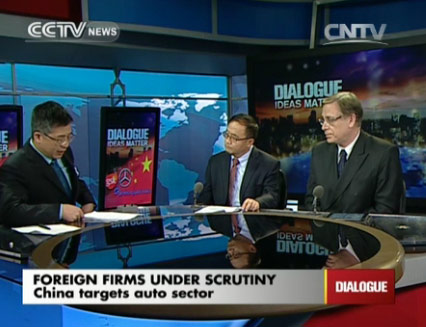
CCTV Dialogue: Foreign Firms Under Scrutiny

China Central Television, August 7, 2014


Dialogue 08/07/2014 Foreign firms under scrutiny
Host: Yang Rui
Yang Rui
Yang Rui
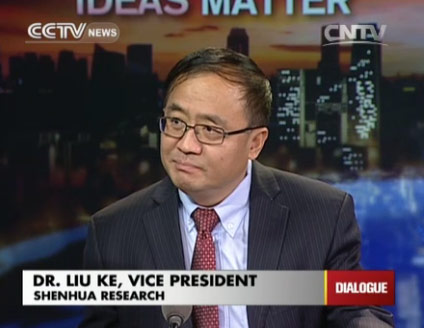
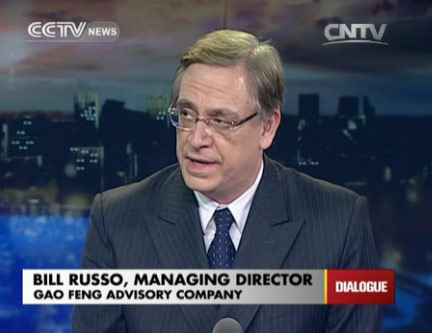
Studio Guests:
Dr. Liu Ke, Vice president of Shenhua Research
Bill Russo, managing director of Gao Peng Advisory Company
Bill Russo, managing director of Gao Feng Advisory Company

5.22.2014

Ford Gets In The Fast Lane

CKGSB Knowledge, February 19, 2014


The high-decibel Shanghai launch of the all-New Ford Mustang
US automobile major Ford is stepping on the gas in China, the world’s largest auto market. Can it catch up with rivals General Motors and Volkswagen?

In December 2013, an enormous red dome appeared on the banks of the Huangpu river in Shanghai. Nearly 450 people converged under this dome, and watched spellbound as a 360-degree screen projected dazzling images. And with great fanfare, Ford Motor Co. launched the all-new Mustang.

Auto enthusiasts are used to high-decibel car launches such as this one. The glamor, glitz and festivity is now pretty much de rigueur.

Yet the Mustang launch was special for one reason. It signaled very clearly that China was now a key market for the Dearborn, Michigan-based automaker: the Shanghai launch event was one of the six global events occurring simultaneously in Sydney, New York, Los Angeles, Dearborn and Barcelona.

(Click to enlarge)
Ford has had China on its radar for a while now. As early as the 1910s the company exported its iconic Model T to China. It set up a presence here in 1995. In 2009, it even moved its Asia headquarters from Bangkok to Shanghai to increase its market penetration and capture a larger share of China’s auto pie. Ford makes for an interesting case study at this point for two reasons. One, it surpassed Toyota and Honda in sales to move up to the fifth rank in China. Two, Ford Focus has emerged as the top selling nameplate (as per IHS Automative sales data) in the passenger vehicle market in the country in 2013. Interestingly, while Ford registered a 35% gain in sales in December, GM, which had occupied the number one position so far, saw a slump of 6.3%.  (See chart below.)

(Click to enlarge)
The year 2010 marked a clear turning point in the history of the automobile industry. For the first time in 120 years, the US market was no longer the biggest. In a special report published in September 2013, American financial services company Standard & Poor’s (S&P) called it a “shift in the balance of power in the auto industry”. The scale had tilted in favor of the emerging markets led by China, India, Brazil and Eastern Europe. Together they accounted for slightly more than one half of the 73.2 million light vehicles sold worldwide in 2010! The share of emerging markets has steadily grown since–in 2011 it was 52%; in 2012, 54%; and in 2013, 55%.

Clearly, this trend held promise. And China, having overtaken the US, has emerged as the largest single-country, new-car market. Demand shot through the roof, telling the best of analysts how conservative their estimates had been. McKinsey & Co in its report, Bigger, Better, Broader: A Perspective on China’s Auto Market in 2020, estimated sales in China to touch 22 million in 2020. Way too late, considering that China came pretty close to achieving that feat in 2013 itself. If estimates by the China Association of Automobile Manufacturers (CAAM) hold true, the market will grow by 10% this year, taking the sales figure over 24 million.

McKinsey’s findings stemmed from the optimism imbued in the Chinese economy and those factors are still intact. Between 2011 and 2020, the Chinese economy is expected to continue growing at 7-8% annually; the percentage of the population residing in urban areas is expected to rise from 51% to 60%, thus giving a fillip to mobility demands; and the number of high-income urban households is likely to expand from 17% to 58%.

Neil Wang, Partner and Managing Director for business consulting firm Frost & Sullivan, China, reiterates: “China has become one of the most important markets for all global car manufacturers as most of them are facing a decline in demand caused by severe economic downturn.” As the recession set in, the Big Three–General Motors (GM), Ford and Chrysler–faced tremendous heat in the US. Unlike GM and Chrysler, Ford abstained from filing for bankruptcy and instead took a $23.5 billion secured loan by putting its iconic blue oval logo as collateral. Calling China a savior may not be wrong. Consider GM’s vehicle sales volume for year 2010–73.6% of it was generated outside the US, including 43% from emerging markets, such as Brazil, Russia, India and China (BRIC). For Ford as well the Asia-Pacific and Africa region (APA) is the fastest growing. By the end of this decade, it expects 60-70% of its growth to come from APA. China undoubtedly remains the star of the region.


Bill Russo, President and CEO of Synergistics Ltd., an automotive consultancy based in China, agrees on China’s prospects. “Urban middle class population and GDP levels will continue to rise, driving expansion. Rising wealth will continue to allow for a strong mix of premium models. Moreover, Chinese consumers favor famous foreign brands. Three out of four passenger cars sold in China carry a foreign brand.” According to CAAM too, the market share of Chinese brand passenger cars has continued to decline, making China the best bet for foreign players like Ford, GM and Volkswagen.


The ‘15 by 15’ Model

Ford China, one of the frontrunners eagerly seeking to tap China’s potential, is upbeat. The company sold 935,813 wholesale vehicles in China in 2013, a 49% increase over the previous year. John Lawler, Chairman and CEO of Ford China, interpreted the impressive performance as a “demonstration” of the continued progress of Ford’s “aggressive China growth strategy”.

(Click to enlarge)
Interestingly, the American auto major has pretty much adhered to the same strategy with which it entered China about two decades back–leveraging its global assets while simultaneously investing in local capabilities to bring a full line-up of vehicles. 

Research helped Ford understand that discerning Chinese customers keep in mind a number of factors before buying a car–fuel economy, design, how the vehicle matches their personality, etc. “(A) car is a major purchase in life, especially in China… it is a whole family affair where everyone, right from the buyer’s spouse to kid to parents, comes for the test drive and acts as a major influencer,” says Lynn Ouyang, a communications executive at Ford Asia Pacific.

Next steps followed. Regular surveys were conducted to understand customer’s preferences. Ford embedded Chinese and Indian engineers in product development groups so that local tastes could be designed into its vehicles. “The Chinese prefer robust back seats for sedans, plush leather, more in-car entertainment options… At the same time China is a very cost-conscious and diverse market,” adds Ouyang.

In adherence with the global One Ford plan (introduced in 2008, the One Ford plan seeks to balance Ford’s cost structure with its revenue and market share, accelerate development of new vehicles that customers want, finance Ford’s plan and rebuild its balance-sheet, and work together to leverage its resources around the world), Ford’s portfolio in China was created to include a full family of vehicles–small, medium and large. From performance vehicles (Focus ST, Fiesta ST), and sport utility vehicles (Explorer, Edge, Kuga, EcoSport), to sedans (Mondeo, Focus, Fiesta, S-MAX) and commercial vehicles (Transit).

In March 2012, while launching the Focus, Ford vowed to bring 15 new vehicles to China by 2015. So far, the plans seem to be on track. Last year Ford launched seven new vehicles in China—Focus ST, Fiesta ST, Explorer, Kuga, EcoSport and the all-new Ford Mondeo.

Focus, the sporty mid-size car, turned out to be the game changer for Ford. A bestseller, it led the fleet in 2013 as well with 403,640 wholesales (cars sent to dealerships) sold, up 36% over the previous year. It helped that Ford became the lead sponsor of singing reality show Chinese Idol and was able to connect with the masses. It was a tried-and-tested marketing strategy (Ford also sponsors American Idol in the US) that, Ouyang says, worked well in China as well. In terms of marketing strategy, Ford has also decided to have a pretty robust online presence in order to gain the attention of the 600 million internet users in China.

Gaining Ground in China

But anyone who has travelled to China knows that it is not just a country of the masses. According to a Research and Markets report titled Global Luxury Car Market: Trends & Opportunities (2012-2017), by 2017, the US and China will collectively represent 50% of the global premium opportunity in automobiles. Keeping this in mind, Ford is drawing up plans to introduce the Lincoln brand, a line that has a history spanning a century, in the latter half of this year. These cars will be imported and distributed through an all-new independent Lincoln brand dealer network. Ford’s vision for Lincoln in China is ambitious. “(The idea is) to attract luxury car buyers and offer a very personalized connection with the dealer, that individual touch which makes the brand different,” says Ouyang.

Ford’s roadmap for the future remains unchanged–refreshing the product lineup, expanding the dealer network, and enhancing the production capacity. As part of its strategy, it is looking at strengthening the regional operation by locating its Asia-Pacific team in China. Ford has been operating in China through two joint ventures (JVs): Changan Ford Automobile (CAF) and Jiangling Motors Corporation Ltd. (JMC), which assemble Ford and JMC vehicles for distribution in China. It sure is shifting gears and getting into the fast lane here. “China is the world’s largest growth market, and we expect tier 4 to tier 6 markets to see the greatest growth over the next five years. To cater to the diversified needs, we will further expand our vehicle offerings to increase our market coverage in China from 22% in 2009 to 50% in 2015. We will also more than double the number of CAF dealerships from 340 (as in 2010) to 700 by 2015. JMC dealerships will also almost double from 116 in 2010 to 220 in 2015,” adds Ouyang. Ford has planned to open most of the new dealerships in tier four to tier six cities. Each dealer is chosen with utmost care–one that offers high level of customer service and does not hard sell to customers.

China’s auto market is not an easy one to navigate. Bill Russo of Synergistics Ltd. says the first order drivers of success in the market can be linked to product relevance and brand acceptance which are often the barriers to market entry. “While these are essential, the secondary drivers of success are more complex,” he says. These include local partner strategic alignment, JV management, R&D localization, competitive cost structure/local sourcing, manufacturing localization, and distribution network capability (for sales and service). According to Russo, the market leaders are Volkswagen (with SVW and FAW-VW/Audi), General Motors (with SGM and SGM-Wuling), Hyundai (with Beijing Hyundai), and BMW (Brilliance-BMW).  “More recently, Ford has gained ground because they are investing in introducing new products which allows them to clear the first-order drivers of success,” he adds.

Here’s a glimpse: Ford has invested over $4.9 billion in China and employs over 26,000 people in its wholly-owned entities and JVs. It currently has nine plants in the country, including three new plants and a research and engineering center under construction. Success in terms of financial returns is difficult to judge because Ford does not break up its revenues country-wise. “Ford Asia Pacific will account for 60-70% of the company’s growth in the next 10 years. China is a big part of it,” says Ford’s Ouyang.

Frost & Sullivan’s Neil Wang points at two crucial challenges that may have a bearing on the success of any MNC auto major in China: the local governments from Tier 1 and even Tier 2 cities, including Beijing, Shanghai, Guangzhou and Tianjin have issued strict policies to control the growth of vehicles. “More cities, like Chongqing, Chengdu and Hangzhou, may issue similar policies to limit the new car sales and registration to ease the issues of urban traffic congestion and air pollution in the coming future. The pricing strategy is equally, if not more, important. Majority of the Chinese customers are first-time buyers and are therefore quite sensitive towards the cost of affording a car—the retail price of the vehicle and even the upcoming maintenance cost.”

Ford is trying to address these concerns. “Locally-produced vehicles do have a price advantage over imported ones,” says Ford’s Ouyang. So as the vehicles roll out of Ford’s manufacturing plants, the Chinese customers stand to gain in terms of price value. He adds, “When we produce 1.2 million vehicles locally, the scale will help us in achieving resource optimization and in getting better prices from the suppliers. We will be able to pass on that value to our customers.”

For the rising environmental concerns, Ford banks on technology to improve fuel efficiency and reduce carbon dioxide emissions. It is working towards bringing 20 new powertrain products to the country and improving fuel economy by up to 20% (compared to 2010) by 2015.

Despite the fact that Ford entered China almost two decades back, it has much ground to cover before it can inch closer to GM and Volkswagen, the two players that currently lead in China. The two early birds started investing heavily in China in the 1990s, long before Ford. But for now, there is no denying that Ford is playing the catch-up game pretty well. 

Click here to read this article at CKGSB Knowledge

5.04.2014

Bill Russo to Chair Automotive Panel Discussion at 19th CLSA Forum in Beijing

Beijing, China, May 12, 2014

Venue:  Grand Hyatt Hotel, Beijing
Time:  11:30am


Panel Discussion Overview:

China’s Automotive Market in Transition

Following a decade of rapid growth that culminated in a stimulus-driven surge in demand in 2009-2010, the China auto market sharply decelerated, with growth slipping to 2.5% in 2011 and 4.3% in 2012.  This brief slowdown was followed by 14% growth in 2013, with overall sales exceeding 22 million units.  While the market growth has been spectacular, there are rising concerns on the sustainability of this performance as the market may be approaching a saturation point in the traditionally strong coastal regions.  Intense competition among automakers as they pursue emerging growth opportunities in specific regions and segments is anticipated.  The aim of this session is to discuss opportunities and challenges faced by different competitors as they deal with this a transitional period in the world’s largest automotive market.

  • Opportunities and challenges in luxury and imported vehicles market
  • Opportunities and challenges in emerging provinces and cities, as well as in second and third tier cities
  • Sales and marketing strategies to exploit these opportunities
  • Strategies to diversify profit streams and maximize profit opportunities
  • Structural changes that may occur as the market transitions to a slower growth pattern


Mr. Uwe Stadtler, CEO of BMW Automotive Finance (China) Co., Ltd.
Mr. Manto Wong, CFO, Ford China
Dr. Joerg Mull, China EVP and CFO, Volkswagen China

Moderated by:
Mr. Bill Russo

11.25.2013

Bill Russo to Speak on Technology Innovation in the 21st Century Automotive Industry

NextGen Auto International Summit, Shanghai, China, December 9-10, 2013

09:00-09:30:  Bill Russo Presentation

Technology innovation frontiers: How rapidly emerging markets are reshaping the 21st Century global automotive industry

  • Seven new technology frontiers emerging to address the mobility challenges of the 21st Century
  • How will China’s continuing growth momentum shape the world’s most important auto market?
  • To what extent will China be able to drive standards and architecture of future automotive technology?
  • How will increasing urbanization impact the nature of future personal and commercial transportation?
  • Despite slow commercialisation progress, what are the global auto industry implications of China’s ambitious program to electrify transportation?
  • What can companies do to master the frontiers of innovation and commercialise at competitive cost to dominate the global auto industry?


10:20-10:50 Panel Discussion

Discussion and Q&A - How does the hybrid vehicle opportunity compare with alternative technologies - Which types of hybrid and EV are likely to have a sustainable future?

Panelists include:

Mr. Bill Russo, Founder and President, Synergistics, China
Mr. Zhuo Zhang, Research Associate, Lux Research, USA
Dr. Song Jian, Professor and President, Automotive Engineering Development
Institute, Dept. of Automotive Engineering, Tsinghua University

Plus:
Mr. Yale Zhang, Managing Director, Automotive Foresight (Shanghai) Co. China


11.22.2013

Japanese carmakers rue lost lead in China

The Financial Times, November 21, 2013


Troubled times at Toyota: sales fell precipitously last year in China
in the wake of a high-profile diplomatic dispute and strikes at car plants over pay

By Tom Mitchell in Guangzhou and Jennifer Thompson in Tokyo

Toyota and Honda picked a bad time to take their foot off the accelerator in China.

As the global car market went into a financial crisis-induced tailspin in 2008, Chinese demand kept expanding, accounting for one-third of the industry’s total growth over the ensuing five years.

Last year, annual sales of passenger cars and minivans remained 9 and 14 per cent below their pre-crisis peaks in the US and western Europe respectively, and recovered to 2007 levels in Japan, according to automotive consultancy AlixPartners. Meanwhile, sales in China’s market more than doubled to 18.6m, making it the world’s largest.

“The downturn didn’t really happen in China,” says Bill Russo, a former US auto executive and Beijing-based industry consultant. “China’s share of the global market rose significantly in 2009 and 2010.”

Toyota and Honda missed the party. Together with Nissan, the “big three” Japanese auto companies’ combined share of the China market crashed from more than one-quarter in 2008 to just 15 per cent in the first half.

Toyota and Honda at least have some interesting excuses. Japanese car companies make for easy targets in China, especially at times of political tension between Asia’s two largest economies.

Chinese nationalist passions boiled over in September last year, after the Japanese government purchased the disputed Senkaku Islands – known in China as the Diaoyu – from their private owner. Japanese car companies briefly halted production as angry crowds targeted their cars and dealerships.

Some Chinese drivers cleverly presented the mob with a moral dilemma – and saved their Japanese cars – by plastering the vehicles with stickers of Chinese flags and other patriotic symbols.

“We lost 50 per cent in sales immediately,” Carlos Ghosn, chief executive of Nissan, said as he delivered first-half results earlier this month. The carmaker is yet to regain the 7.7 per cent market share it enjoyed before the dispute.

Toyota’s vehicle sales also dropped rapidly, with many customers cancelling orders and shunning showrooms. It was forced to reduce production temporarily in some plants by as much as 60 per cent.

Japanese auto executives admit that the severity of the incident took them by surprise, given that previous geopolitical flare-ups had not seriously affected production. “Japanese carmakers always feel that [when it comes to] doing business in China we don’t stand on the same point as western carmakers,” says one industry insider. “We always have to overcome these past political problems.”

Ivo Naumann, AlixPartners’ Shanghai-based managing director, says: “The biggest problem [with these incidents] is on the dealer side. If sales decline or your windows get smashed every three or four years because of some stupid political issue, you ask whether you should continue.”

A series of industrial actions in 2010 that marked the beginning of the end of China’s cheap labour advantage also primarily affected Japanese car plants in southern China. The striking auto workers drew on lingering resentment over their country’s former wartime adversary.

Many analysts, however, do not accept that geopolitics has been the main reason for Toyota and Honda’s poor performance in China over recent years. They point instead to inadequate plant expansions, low levels of localisation and other strategic errors that were made before Sino-Japanese relations hit their latest nadir.

After last year’s turmoil, Toyota’s sales this September rose 45 per cent year on year, according to market research consultancy LMC Automotive, which collates data for every player in the market, while Honda and Nissan’s China business doubled.

But all three companies’ sales over the first three quarters of 2013 remained largely flat or slightly down versus the same period last year, even as the overall market grew a robust 15 per cent.

“The Japanese took a negative view of the market,” says Mr Naumann. “They simply ran out of capacity. There was demand but they just couldn’t supply it.” Toyota in particular, he adds, badly underestimated how fast the market would grow.

Toyota enjoyed a bumper 2008 in China, attaining a 10 per cent market share and becoming the country’s second-best-selling brand after Volkswagen.
But as the global financial crisis took hold, it froze development of a major plant in Changchun, a northeastern industrial centre, and delayed approval for capacity increases at other facilities. The Changchun plant, originally slated to have begun manufacturing in 2010, finally opened last year with an annual capacity of 100,000 vehicles. “We never thought of [China] as an El Dorado,” one Toyota executive admits.

GM is now firmly entrenched in the number two slot.

Some analysts are optimistic that Toyota and Honda have learnt from their mistakes and can bounce back, although it will be a difficult task in what is now the most competitive national market in the history of the auto industry. More than 100 manufacturers are active in China including every major multinational car company.

“They will regain market share,” says Mr Naumann. “They are still formidable companies. They still have excellent cars.”

Tatsuo Yoshida, auto analyst at Barclays, also believes Japanese manufacturers are at last addressing their deficiencies in China after concerns about intellectual property protection had for years dissuaded them from developing more vehicles there. But he expects that the US will remain their key market.


Additional reporting by Henry Foy in London