


Israel is seeking opportunities to export its technology, and China, with its abundant capital and hunger for innovative technology, has become a prime choice for setting up partnerships, Shanghai-based China Business News reports citing Israeli investment consultants.
Showing posts with label China. Show all posts
Showing posts with label China. Show all posts
3.04.2016
6.22.2015
Israeli investors keen to cooperate with China
Want China Times, June 6, 2015

Click here to read the original article

The flags of China and Israel. (Photo/CFP)
"From the views of enterprises, compared with Europe and the United States, we prefer to collaborate with Asian nations, particularly China, given the good historic and cultural relations between Israel and China," said Uri Kushnir, a managing partner at Israeli technology transfer company 31 Degrees North Innovation Exchange.
Kushnir and his partner Guy Pross arrived in China in late May and signed a strategic partnership agreement in Shanghai with Gao Feng Advisory Company, a China-based international consultancy firm.
Israel and the United States have maintained close ties, but the Israeli government began developing an interest in Chinese firms and the Chinese market in recent years.
China is expected to surpass the United States as the largest overseas participant in the Israeli government's development projects in the next two years, said Avi Luvton, executive director of the Asia Pacific Department at the Israeli Industry Center for Research and Development.
According to Israeli government statistics, technology transfer deals made by companies of the two countries were estimated to have reached US$300 million in 2014, up from US$50 million in 2013.
The two countries have differences, however, including their motivation in pursuing technological innovation, Kushnir said.
Israel's pursuit of innovation has been driven mainly by its limited resources and the pressure on the country for survival.
China is a large country with abundant resources and a massive market that has pursued innovation because of its desire for success and the need to improve its people's livelihood, Kushnir said.
With Chinese enterprises pursuing globalization, Israel's globalization and its innovative ideas may help provide inspiration to China, said Bill Russo, managing director at Gao Feng Advisory Company.
In addition, Israel's advanced technology transfer will help Chinese companies to increase the sale of high-technology products abroad, Russo said.
Click here to read the original article
4.24.2015
How China Brands Took Over the World’s Hottest SUV Marke
Bloomberg Business, April 17, 2015

BYD Co.'s Sport-Utility Vehicles
BYD Co. S6 sport-utility vehicles (SUV) move along the production line at the company's assembly plant in the Pingshan district of Shenzhen, China. Photographer: Brent Lewin/Bloomberg
After years of losing out to foreign brands, China’s automakers are winning in the world’s hottest SUV market by employing a tried-and-tested strategy: offering them cheap.
By flooding the market with comparable models at lower prices, Chinese automakers accounted for eight of the 10 bestselling sport utility vehicles in the first quarter, crowding out global nameplates like Toyota Motor Corp.’s RAV4 and Honda Motor Co.’s CR-V.
Chinese-branded SUV sales more than doubled in the first quarter to overtake foreign nameplates in the segment this year, accounting for 56 percent of all deliveries, according to data from the China Association of Automobile Manufacturers. At the Shanghai auto show next week, Honda will unveil a full-sized SUV concept that will compete for attention with local offerings like BYD Co.’s new Song and Yuan SUVs.
“A significant number of Chinese consumers are looking for a more affordable alternative to premium-priced foreign SUVs,” said Bill Russo, a Shanghai-based managing director at consultant Gao Feng Advisory. “Foreign automakers now need to price more aggressively as the market matures and becomes more hyper-competitive.”
Almost half of the new and refreshed passenger vehicles slated for debut this year in China are SUVs, with about three-quarters of them from local automakers, according to estimates by Bloomberg Intelligence.
Cheaper SUVs
Global automakers are competing against names little known outside China: Anhui Jianghuai Automobile Co.’s Ruifeng S3, BAIC Motor Corp.’s Huansu and Chongqing Changan Automobile Co.’s CS35 all rank in the top 10 by sales. Great Wall Motor Co.’s H6, the most popular SUV in China, costs about half the price of Volkswagen AG’s Tiguan.
The average price of the bestselling Chinese SUVs in the first quarter was was 82,900 yuan ($13,380), versus 167,300 yuan for the foreign makes, according to dealership quotations compiled by Autohome, a car-pricing website.
The addition of new models is being accompanied by a surge in production. Annual output of SUVs in China is estimated to reach more than 7.04 million units in 2018, up from 4.32 million last year, according to researcher IHS Automotive.
Rare Win
The SUV success represents a rare win for China’s automakers, which have struggled despite heavy government intervention. Foreign companies are required to set up joint ventures with local carmakers to operate in the country, sharing profits and technology.
Utility vehicle sales accounted for 24 percent of the total passenger-vehicle market in the first quarter. Local carmakers have been fast to catch the shift in consumer preference from traditional sedans to more spacious crossovers, and fill the gap in the market for lower-priced alternatives.
“It’s about time Chinese automakers gained back some territory after losing out to foreign brands for so many years,” said Cao He, a Beijing-based analyst at China Minzu Securities Co. “But they have to watch their backs and make sure the growth is sustainable and they don’t put all their eggs in one basket.”
Bill Russo to chair Automotive CEO Dialogue at J.P. Morgan Global China Summit
Beijing, China, June 3, 2015
Gao Feng’s Managing Director and Auto Practice leader Bill Russo will chair a panel discussion titled The Next Golden Age of China Auto Industry at 11:15am on Wednesday, June 3.
CEO Dialogue: The Next Golden Age of China’s Automotive Industry
Hubertus Troska, Member of the Board of Management, Daimler AG; Chairman & CEO, Daimler Greater China
Karsten Engel, President and CEO, BMW Group China
Jochem Heizmann, Member of the Board of Management of Volkswagen AG, President & CEO Volkswagen Group China
Chair: Bill Russo, Managing Director, Gao Feng Advisory
2.23.2015
1.28.2015
Restructuring will set stage for new golden age of China's auto industry
South China Morning Post, January 21, 2015

Click here to read this article at SCMP.com
The old automotive industry model - a way to provide mobility for middle-class consumers - no longer
fits the Chinese context, creating opportunities for innovation.
After a decade of breathtaking growth, China surpassed the United States as the world's largest automotive market in 2009. Since then, in spite of a recovery in US sales, China has widened the gap, with sales of 23.5 million vehicles compared with 17 million in the US.
However, the 7 per cent growth of last year was about half that achieved in 2013. In fact, China has witnessed single-digit growth in three of the past four years, prompting many market followers to label this the "new normal". Some say the best times for China's automotive industry are now in the past.
Indeed, there are many reasons to worry. In addition to the overall slowdown of China's economy, a growing number of cities are implementing curbs on car sales, seeking to address concerns about congestion and emissions. Last month, Shenzhen joined a growing list of cities, including Beijing, Tianjin , Shanghai, Guangzhou, Hangzhou and Guiyang , in an effort to cut the growth of the car population by limiting purchases.
Meanwhile, the rising inventory of unsold vehicles has prompted the China Automobile Dealers Association to openly challenge global brand-name manufacturers, including BMW and Toyota, to increase incentives to their dealers and lower sales targets for 2015. While there is certainly cause for concern in the near term, we believe China's auto market is moving into a new phase, one that still offers the most profitable growth opportunities in the world for both local and global carmakers. Indeed, China's auto industry is on the cusp of major change that will fundamentally reshape things, bringing both opportunities and challenges.
The age of inefficient, asset-driven growth is over. Overall, there is a capacity bubble after some manufacturers over-estimated growth prospects. The problem is worst at the middle and lower end of the market. An already hyper-competitive environment will become more cutthroat as manufacturers try to undercut competitors' prices to sell excess stock.
Restructuring China's auto industry is essential to ensure its stable and healthy development. Government policies were implemented over 30 years ago to allow China to acquire the capabilities and capital from foreign sources to build up its domestic industry. While this has helped spur overall growth, it has not yielded a strong base of domestic carmakers. Consolidation and the elimination of weaker brands is inevitable.
China's automotive industry will continue to expand, but at a more sustainable rate, with a steady stream of first-time purchasers from lower-tier cities joining the repeat buyers and those upgrading in the more established regions.
A more "binary" market will emerge, with consumers in upper-tier cities continuing to prefer global brands, while those in lower-tier cities will seek no-frills products.
However, pockets of "new wealth" will emerge in lower-tier cities, too, and these people will begin to mimic the buying patterns of more affluent customers.
This presents unique opportunities for both foreign and domestic manufacturers. For example, Ford and Great Wall anticipated the shift towards small SUVs and have been enjoying above-average growth. Likewise, European luxury carmakers, such as Audi, BMW, Mercedes-Benz and Land Rover, have seen sales rise exponentially in recent years as a result of the growth in the number of high-net-worth consumers.
In future, new segments, such as crossover and multi-purpose vehicles, may emerge but they may not be as large or as profitable as the SUV/luxury sectors. Thus, we believe a new golden age is on the horizon for China's auto industry. China remains the largest and fastest-growing automotive market in the world. After years of advances in mobile connectivity, big data and social networks, "internet of vehicles" technology is now shaping the industry as "connected mobility" drives advances in navigation, analytics, driver safety and driver assistance.
The old automotive industry model - a way to provide mobility for middle-class consumers - no longer fits the Chinese context, creating opportunities for innovation.
A new solution to personal urban mobility is likely to emerge in China, given the scale of its urban transport challenges and increasing concerns over the environmental impact of conventional vehicles. Indeed, the traditional car-ownership model is being reshaped by urbanisation, the rising aspirations of young consumers, and the development of communications technology and "big data".
A number of new concepts are emerging, bringing non-traditional players, many of whom are Chinese, into the ecosystem. Examples include taxi-hailing apps such as Alibaba's Kuaidi Dache and Tencent's Didi Dache, which each process over 5 million transactions a day.
As the leading automotive market, China is poised to revolutionise the global car industry, ushering in the next age of smart vehicles and connected mobility.
Edward Tse is founder and CEO, and Bill Russo is managing director, at Gao Feng Advisory Company, a global strategy and management consulting firm with roots in Greater China
Click here to read this article at SCMP.com
Toyota Isn't in Tune With China's Needs: Russo
Bloomberg Television, January 22, 2015
Gao Feng's Managing Director Bill Russo discusses China's car market snd why the country is so important for automakers with Bloomberg's Rishat Salamat on "On The Move".


http://www.bloomberg.com/news/videos/2015-01-22/toyota-isn-t-in-tune-with-china-s-needs-russo
Gao Feng's Managing Director Bill Russo discusses China's car market snd why the country is so important for automakers with Bloomberg's Rishat Salamat on "On The Move".
http://www.bloomberg.com/news/videos/2015-01-22/toyota-isn-t-in-tune-with-china-s-needs-russo
Toyota Poised to Lose Global Sales Lead to VW on China
Bloomberg News, January 22, 2015

http://www.bloomberg.com/news/articles/2015-01-21/toyota-poised-to-lose-global-sales-lead-to-vw-on-china
Toyota Motor Corp., which fended off Volkswagen AG to remain the world’s top automaker in 2014, may lose the sales crown as early as this year as it falls behind in China, the world’s biggest auto market.
Toyota is predicting its global deliveries will decline 1 percent in 2015 to 10.15 million vehicles, or just 10,000 units more than what Volkswagen sold worldwide last year. A new factory the German company is opening this year in Changsha, China, will add capacity for another 300,000 vehicles annually.
As Volkswagen and General Motors Co. add factories to bolster their already-dominant position in China, Toyota President Akio Toyoda’s strategy of foregoing new car plants until at least next year could result in the first shakeup in auto-sales leadership since 2011. Toyota ranks sixth among global automakers in China and sells less than one-third as many vehicles as its two main competitors in China.
“The difference is that Volkswagen has a jet engine strapped to its back called ’China’,” said Bill Russo, Shanghai-based managing director at Gao Feng Advisory Co. “Toyota, unfortunately, is in a position of weakness when it comes to the China market. It would be almost impossible to hold on to a number one position without being in the lead in China, and Toyota’s not even in that league.”
Worldwide sales for Toyota, including at its Hino Motors Ltd. and Daihatsu Motor Co. units, climbed 3 percent to 10.23 million vehicles in 2014, according to a company statement. Volkswagen last week reported a 4.2 percent gain to 10.14 million vehicles, that included its two heavy-truck units. GM followed with sales of 9.92 million units, up 2.1 percent. Volkswagen and GM haven’t announced projections for this year.
China Capacity
Toyota, which hasn’t built an assembly plant in China since 2012 and faces a self-imposed moratorium on new factories until next year, will fall behind even further as Volkswagen and GM step up their expansion plans.
GM has announced plans to add five new plants in China by 2018 even though President Dan Ammann said the market is “maturing rapidly.”
Volkswagen expects to raise its China plant capacity to more than 4 million vehicles by 2018 from 3.1 million at end 2013, according to the company. Mainland China and Hong Kong accounted for a record 3.67 million deliveries at Volkswagen group last year, up 12.4 percent and extending the country’s lead as the German manufacturer’s largest single market.
Sales Target
By comparison, Toyota missed its sales projection for 1.1 million units in China in 2014, even as the Corolla and the Levin compact cars helped boost sales 13 percent to 1.03 million units. The company kept its China sales target unchanged for this year.
Even though Toyota may cede the sales leadership, it still outearns Volkswagen. Analysts estimate Toyota earned a profit of 1.96 trillion yen ($16.7 billion) last calendar year, compared with 10.7 billion euros ($12.4 billion) at Volkswagen.
“Their focus is not No. 1,” said Peggy Furusaka, a Tokyo-based auto-credit analyst at Moody’s Investors Service. “Toyota is more concerned about keeping profitability than chasing numbers. So for coming years, I wouldn’t be surprised to see Toyota selling fewer cars than Volkswagen.”
Toyota’s also-ran status in China is compounded by threats by its dealers to drop out of its network, citing poor sales and a lack of profit.
Dealer Threats
As many as 10 percent of dealers for one of Toyota’s China ventures could abandon the brand, according to the China Automobile Dealers Association. Among the 523 distributors in the FAW-Toyota Motor Sales Co. group, 95 percent are losing money, with some dealers stopping sales or shutting down altogether because of the losses, the state-backed dealer’s group said.
Vehicle sales growth slowed last year in China in tandem with the nation’s weakest economic growth since 1990. Deliveries are forecast to gain 8 percent to about 21.3 million passenger vehicles this year, according to the state-backed China Association of Automobile Manufacturers.
“As long as China is growing rapidly, Toyota will need to build new factories there,” said Yoshiaki Kawano, an analyst with IHS Automotive in Tokyo. “They are probably reserving some energy for growth in the longer term, as they are trying to improve the efficiency at their existing plants.”
To contact Bloomberg News staff for this story: Alexandra Ho in Shanghai at aho113@bloomberg.net; Ma Jie in Tokyo at jma124@bloomberg.net; Masatsugu Horie in Osaka at mhorie3@bloomberg.net
To contact the editors responsible for this story: Chua Kong Ho at kchua6@bloomberg.net Suresh Seshadri
http://www.bloomberg.com/news/articles/2015-01-21/toyota-poised-to-lose-global-sales-lead-to-vw-on-china
1.19.2015
Chinese Car Buyers Embrace Online Sales, Dealers Still in the Loop
Car Scoops. January 11, 2015

http://www.carscoops.com/2015/01/chinese-car-buyers-embrace-online-sales.html
E-commerce is nothing new, especially in what is probably the world’s most connected country: China. The thing is, Chinese are embracing online sales for new cars, too – and that’s good for business.
Local automaker Geely estimates that it has sold nearly 3,000 units in 2014 online five years after first launching its e-commerce website. “The impact of Internet firms has been a major success for the company”, company spokesman Ashley Sutcliffe said.
Paul Hu, Volkswagen Group China’s chief marketing officer for Greater China and ASEAN, is even more buoyant: “E-commerce in the automotive market is taking off”, he told Wards Auto. “In my personal opinion, online sales in the total car market in China will account for 10 percent in the near future.”
Still, traditional dealers are not left out of the game. One of VW’s joint ventures, Shanghai Volkswagen, is selling cars online through a number of websites; customers place the order in one of the sites but have to close the deal and pick up the vehicle from a dealership.
Kyle Dickie, CEO of dealership best-practices consultancy Sewells Group, thinks that “there is some disruption to come to the distribution model, but it is not imminent. In China, there is an unusually high level of trust still placed in the sales consultant. Consumers want to interact face to face.”
The “disruption” mentioned by Dickie are smartphones. Right now, China is estimated to have more than 500 million smartphone users who, naturally, use their devices buying stuff online. Beijing-based iResearch forecasts that 2014 online retail sales in the country increased by 45.8 percent to 2.76 trillion RMB (US$444 billion).
“Empowered with technology, consumers of mobility services are likely to make choices other than what the automakers and their dealers are offering today”, commented Bill Russo, the managing director of the Gao Feng consultancy firm.
In other words, e-commerce may bring customers to the dealerships – they just might not be interested in the same vehicles the dealer and the brand want to promote.
http://www.carscoops.com/2015/01/chinese-car-buyers-embrace-online-sales.html
1.17.2015
China in 2025 and Implications for Automakers
Gao Feng Insights Report, January, 2015
Dear Friends of Gao Feng,
Dear Friends of Gao Feng,
We are pleased to share with you a report titled: China in 2025 and Implications for Automakers. As we know, China’s economy has been growing dramatically for more than two decades. China is now the second largest (and will inevitably soon become the largest) economy in the world. Yet we are recently confronted with rising concern over the impact of a deceleration in overall economic growth, especially in the automotive sector.
Since 2011, we have seen single digit growth in 3 of the past 4 years, raising questions over the future prospects for the industry. In this analysis, we seek to avoid the trap of “driving by looking in the rear-view mirror”, and instead look in front of us at the plausible scenarios which may unfold which will impact the auto industry over the next decade.
We believe that China’s economic growth is likely to continue over the next decade, driven by a mix of continued (albeit more selective) fixed-asset investment and growth in consumption. A broad transformation is expected to continue and will present an environment that is characterized by a long-term and sustained shift towards a middle-income, consumption-based economy. This trend would lead to a profoundly different economic landscape.
We also believe that discontinuities int eh political, social and economic landscape have the potential to reshape China dramatically by 2025. While the outlook is positive, there will likely be discontinuities - both upward ad downward - along the way. The key to sustainable success for businesses in such an environment depends on an ability to anticipate the trends and challenges that are in the “blind spots” today - but which can create disruptive threats or discontinuous opportunities for those who can respond rapidly. In essence, and “early warning system” is needed which leverages unique insights which can be brought to bear on the question of how the market, the regulatory system, and business models may develop over the next decade in China.
We welcome your comments and feedback on our briefing paper or in general about our firm. We would be glad to meet you in person to share our data and perspectives in a fuller manner. Please let us know if you are interested in meeting and discussing directly how we can help you to operationalize these insights.
Thought leadership is core to what Gao Feng does. We will, from time to time, share with you our latest thinking on business and management, especially as it relates to China and China’s role in the world.
Best Regards,
Dr. Edward Tse
CEO, Gao Feng Advisory Companyedward.tse@gaofengadv.com
CEO, Gao Feng Advisory Companyedward.tse@gaofengadv.com
Bill Russo
Managing Director, Gao Feng Advisory Companybill.russo@gaofengadv.com
Managing Director, Gao Feng Advisory Companybill.russo@gaofengadv.com
Chee-Kiang Lim
Principal, Gao Feng Advisory Companyck.lim@gaofengadv.com
Principal, Gao Feng Advisory Companyck.lim@gaofengadv.com
Tel: +86 10 8557 0676 (Beijing); +852 2588 3554 (Hong Kong); +86 21 5117 5853 (Shanghai)
Gao Feng website: www.gaofengadv.com
11.08.2014
China’s antitrust fines for foreign car companies fail to stall growth
The Financial Times, November 3, 2014

For multinational car companies operating in China, the euphoria from the biggest ever automotive boom in industrial history is finally being tempered by some unexpected risks, most notably a controversial investigation by the National Development and Reform Commission (NDRC) into allegedly anti-competitive behaviour by Audi, Mercedes-Benz and other brands.The investigations have so far resulted in fines that are peanuts in comparison to the vast profits that foreign automakers have enjoyed over recent years – and continue to enjoy.

In July, a joint venture between Volkswagen unit Audi and state-owned First Auto Works was ordered to pay $41m for alleged violations of China’s 2008 Anti-Monopoly Law. This compares with reported operating profits of $12.2bn for VW’s joint ventures in China (its other is with SAIC Motor) last year.
Fiat unit Chrysler was also hit with a small fine this summer, while Daimler’s joint venture with BAIC Motor, which makes Mercedes-Benz saloons, is still awaiting the outcome of an NDRC investigation after one of its Shanghai sales offices was raided in July.
These fines are the byproduct of a wide-ranging investigation that appears to have a much larger aim – forcing car companies, regardless of whether they are in fact guilty of anti-competitive practices, to lower the prices of their vehicles, spare parts and services.
According to one industry executive, the head of a multinational company’s China operations has told visiting board members that, in view of the NDRC’s offensive, his biggest fear is of a sudden shift in government policy. “It’s bad for business,” the executive says of the investigation. “It has made the investment environment very uncertain.
“If people can afford the cars, they can afford the spare parts and after-sales service,” he adds. “It’s not like the NDRC is lowering the price of medical care or making food cheaper.”
Foreign automobile executives argue that the relatively high prices asked for cars – especially premium vehicles that can be almost twice as expensive in China as they are in the US – is a function of unprecedented demand, even for overseas models subject to expensive import taxes.
China’s car craze began in earnest in 2008-09, during the depths of the global financial crisis, when it overtook the US as the world’s largest car market.
Demand from entire generations of first-time drivers soared in the world’s second-largest economy, just as purchasing power collapsed in the US and Europe – a nadir symbolically marked by Washington’s bailout of General Motors in December 2008.
Over the ensuing half decade, foreign carmakers in China, especially long established ones such as Volkswagen and GM, had a license to print money.
Even last year, when double-digit annual growth was finally expected to taper, annual sales grew by about 15 per cent to 18m passenger cars – 10 times as many as were sold in India.
This year began in similar fashion, especially for foreign brands and their Chinese joint venture companies. Sales of Chinese brands, however, began to fall sharply and their share of the passenger car market tumbled from 27 per cent to 23 per cent.
The precipitous fall-off in sales of local brands and slower economic growth has forced the China Association of Automobile Manufacturers to lower its projection of an 8.3 per cent increase in year-on-year sales this year to 4.6 per cent – two-thirds down on last year.
In the first quarter, Geely, the private sector carmaker most famous for its purchase of Volvo Cars from Ford, saw sales of its own-brand vehicles fall by as much as 40 per cent over the same period a year earlier.
This was despite a gradual improvement in the quality of local-brand cars in China, according to Geoff Broderick at JD Power, which publishes an annual customer survey of 212 models across 62 brands. “The domestic brands are doing exactly what they should be doing – focusing on quality,” Mr Broderick says. “But as we see the quality gap closing, we’re not seeing a pick-up in [local brands’] market share.”
One reason for the fall has been a counterintuitive NDRC requirement that foreign-invested joint ventures develop a local brand for the China market, such as the Baojun saloon manufactured by GM, SAIC and Wuling. Many of these new entrants are priced to compete against domestic rivals, especially in smaller cities where car ownership rates are relatively low.
“I don’t understand what the Chinese government’s objective was in encouraging foreign companies to create local brands,” says Bill Russo, a Shanghai-based industry consultant.
“It only cannibalises already distressed sales of local brands. I think the intent was for more technology to be shared by the foreign companies. But the unintended consequence is to take volume from local carmakers producing similar products,” he adds.
At the other end of the spectrum, foreign carmakers continue to thrive in saturated markets such as Beijing and Shanghai, where premium brands such as Audi, BMW and Mercedes-Benz account for a quarter of the market.
Even now, limits on expensive new licence plates to combat congestion and pollution are spurring their sales, as existing plate holders trade up.
“As cities implement plate restrictions, people gravitate towards premium foreign brands,” says Mr Russo. “They want to put their expensive plates on the best piece of automotive technology that they can.”
Click here to read the article at FT.com
Trading up: premium vehicles cost almost twice as much as in the US
For multinational car companies operating in China, the euphoria from the biggest ever automotive boom in industrial history is finally being tempered by some unexpected risks, most notably a controversial investigation by the National Development and Reform Commission (NDRC) into allegedly anti-competitive behaviour by Audi, Mercedes-Benz and other brands.The investigations have so far resulted in fines that are peanuts in comparison to the vast profits that foreign automakers have enjoyed over recent years – and continue to enjoy.
In July, a joint venture between Volkswagen unit Audi and state-owned First Auto Works was ordered to pay $41m for alleged violations of China’s 2008 Anti-Monopoly Law. This compares with reported operating profits of $12.2bn for VW’s joint ventures in China (its other is with SAIC Motor) last year.
Fiat unit Chrysler was also hit with a small fine this summer, while Daimler’s joint venture with BAIC Motor, which makes Mercedes-Benz saloons, is still awaiting the outcome of an NDRC investigation after one of its Shanghai sales offices was raided in July.
These fines are the byproduct of a wide-ranging investigation that appears to have a much larger aim – forcing car companies, regardless of whether they are in fact guilty of anti-competitive practices, to lower the prices of their vehicles, spare parts and services.
According to one industry executive, the head of a multinational company’s China operations has told visiting board members that, in view of the NDRC’s offensive, his biggest fear is of a sudden shift in government policy. “It’s bad for business,” the executive says of the investigation. “It has made the investment environment very uncertain.
“If people can afford the cars, they can afford the spare parts and after-sales service,” he adds. “It’s not like the NDRC is lowering the price of medical care or making food cheaper.”
Foreign automobile executives argue that the relatively high prices asked for cars – especially premium vehicles that can be almost twice as expensive in China as they are in the US – is a function of unprecedented demand, even for overseas models subject to expensive import taxes.
China’s car craze began in earnest in 2008-09, during the depths of the global financial crisis, when it overtook the US as the world’s largest car market.
Demand from entire generations of first-time drivers soared in the world’s second-largest economy, just as purchasing power collapsed in the US and Europe – a nadir symbolically marked by Washington’s bailout of General Motors in December 2008.
Over the ensuing half decade, foreign carmakers in China, especially long established ones such as Volkswagen and GM, had a license to print money.
Even last year, when double-digit annual growth was finally expected to taper, annual sales grew by about 15 per cent to 18m passenger cars – 10 times as many as were sold in India.
This year began in similar fashion, especially for foreign brands and their Chinese joint venture companies. Sales of Chinese brands, however, began to fall sharply and their share of the passenger car market tumbled from 27 per cent to 23 per cent.
The precipitous fall-off in sales of local brands and slower economic growth has forced the China Association of Automobile Manufacturers to lower its projection of an 8.3 per cent increase in year-on-year sales this year to 4.6 per cent – two-thirds down on last year.
In the first quarter, Geely, the private sector carmaker most famous for its purchase of Volvo Cars from Ford, saw sales of its own-brand vehicles fall by as much as 40 per cent over the same period a year earlier.
This was despite a gradual improvement in the quality of local-brand cars in China, according to Geoff Broderick at JD Power, which publishes an annual customer survey of 212 models across 62 brands. “The domestic brands are doing exactly what they should be doing – focusing on quality,” Mr Broderick says. “But as we see the quality gap closing, we’re not seeing a pick-up in [local brands’] market share.”
Investigations have so far resulted in fines that are peanuts in comparison to the vast profits that foreign automakers continue to enjoy
One reason for the fall has been a counterintuitive NDRC requirement that foreign-invested joint ventures develop a local brand for the China market, such as the Baojun saloon manufactured by GM, SAIC and Wuling. Many of these new entrants are priced to compete against domestic rivals, especially in smaller cities where car ownership rates are relatively low.
“I don’t understand what the Chinese government’s objective was in encouraging foreign companies to create local brands,” says Bill Russo, a Shanghai-based industry consultant.
“It only cannibalises already distressed sales of local brands. I think the intent was for more technology to be shared by the foreign companies. But the unintended consequence is to take volume from local carmakers producing similar products,” he adds.
At the other end of the spectrum, foreign carmakers continue to thrive in saturated markets such as Beijing and Shanghai, where premium brands such as Audi, BMW and Mercedes-Benz account for a quarter of the market.
Even now, limits on expensive new licence plates to combat congestion and pollution are spurring their sales, as existing plate holders trade up.
“As cities implement plate restrictions, people gravitate towards premium foreign brands,” says Mr Russo. “They want to put their expensive plates on the best piece of automotive technology that they can.”
Click here to read the article at FT.com
10.21.2014
Jaguar Land Rover’s first China factory caps carmaker’s resurgence
The Financial Times, October 21, 2014

Click here to read the original article at FT.com
The opening of Jaguar Land Rover’s first China factory caps a five-year resurgence under Indian ownership that has made the Coventry-based company a byword for British manufacturing excellence and export prowess.
The new plant in Changshu, about a two-hour drive from Shanghai, marks a pivotal moment for JLR. The Tata Motors unit needs a manufacturing presence in China to consolidate its position in the world’s largest car market – but also wants to assure its British workforce and the UK government that international expansion will not jeopardise jobs at home.
As part of that effort, JLR is boosting investment at its factories in Liverpool and the West Midlands and this month opens a new £500m engine plant in Wolverhampton – even as it plans to open another manufacturing facility in Brazil. Last week, JLR’s factory in Halewood, Merseyside began producing the new Land Rover Discovery Sport after a £200m investment that created 250 new manufacturing jobs and £3.5bn in supplier contracts.
The Changshu factory, a Rmb10.8bn ($1.8bn) joint venture with state-owned Chery Automobile that opened on Tuesday, will produce JLR’s less expensive Range Rover Evoque for the China market, where the company sells almost five SUVs for every one Jaguar saloon. On Tuesday, JLR said that it also intended to produce a Jaguar saloon model at the factory by 2016.
“The demand that’s here in China will far outstrip [Changshu’s] capacity so we have absolutely zero plans to export any cars whatsoever,” Bob Grace, JLR’s China head, said at this year’s Beijing Auto Show.
Mr Grace hosted UK trade unionists in China at the outset of JLR’s investment programme in an effort to allay their fears. “You can imagine the thoughts that go through their mind when you open a factory in China,” he said.
“When you look at the competitive situation it doesn’t take long to realise that you have to build the cars in China as part of our global aspirations to be a fairly significant player.”
Roger Maddison, at UK union Unite, was one of JLR’s guests and says the union accepts the logic of the Changshu investment but has concerns about the longer-term trend it signals.
“Tata knows what differentiates JLR from other carmakers – it’s British,” says Pierluigi Bellini, analyst at IHS Automotive. “If they start developing cars in, say, India, it’s going to be a different brand image . . . Developing it from scratch – blank white paper to the final design – it’s important to keep that in the home market.”
Tata bought JLR from Ford in March 2008, a week after JPMorgan bought Bear Stearns. When Lehman Brothers went bankrupt six months later, the global financial crisis began in earnest and Ratan Tata, then chairman of the Indian group, had plenty of reasons to regret his purchase.
But the Indian provenance of JLR’s new owner hinted at the multinational nature of its future transformation, which would be built on surging demand in developing economies. The most important of these was China, whose emergence as the world’s largest car market coincided with the US government’s December 2008 bailout of General Motors.
“During the early part of 2009 we were pretty close to the wire as a business,” said Mr Grace. “But I used to come to China once a quarter and got a sense that something different was happening in this place . . . It’s almost a miracle that the [China] factory has come out of the ground in such a short period of time.” JLR’s joint venture with Chery was announced less than two years ago.
Bernstein Research predicts JLR will sell 130,000 vehicles in China this year, compared with 54,000 total units in 2009-2011. The Changshu factory’s initial annual production capacity is 130,000 vehicles but output is expected to ramp up gradually over the next few years.
“No other [carmaker] has benefited as much from China,” Max Warburton, senior analyst at Bernstein Research, wrote in a recent report. The country now accounts for a third of JLR’s total sales and, Mr Warburton estimates, more than half of its earnings before interest, tax and depreciation. In its latest quarter JLR posted pre-tax profit of £924m, on revenues of £5.35bn.
JLR joins the “big three” Germans as the fourth big premium carmaker to begin manufacturing operations in the world’s largest car market. Annual sales of premium vehicles, currently about 1.3m, are expected to reach 2.5m-3m units by 2020. But the Germans dominate the sector, with a combined market share of about 80 per cent.
“There’s lots of opportunity for new premium entrants,” says Bill Russo, a Shanghai-based industry consultant. “The market is underserved. The German three alone can’t continue to maintain that kind of dominant market share. They can’t keep up with demand.”
JLR estimates that local manufacturing has allowed its German rivals to reduce prices by about 15 per cent on average, thanks to savings on import tariffs and other costs. The UK company, by contrast, has what Mr Warburton calls “the most egregious pricing in China”.
In response, Mr Grace says JLR has “worked quite closely with [Chinese regulators] in terms of reacting to the challenges they gave us [on pricing]. We more than met their requirements”. He adds: “We’re not setting the market price – we’re following the market price.”
JLR reduced prices on some Range Rover and Range Rover Sport models earlier this year in China, in response to a concerted campaign by the National Development and Reform Commission to drive down the pricing of vehicles and spare parts.
But the price differential between the same Land Rover models sold in China and other markets remains wide, with a top-end Range Rover selling for the equivalent of £85,400 in China and £44,000 in the US.
Click here to read the original article at FT.com
10.12.2014
Bill Russo to Join Panel Discussion at Global Automotive Forum
Wuhan, China, October 16, 2014
TOPIC:
The Transformation of China’s Auto Dealers
Auto dealers in China thrive on new car sales and highly profitable repair services. What opportunities and challenges do dealers face with the growing number of vehicles on the road, increased competition, the internet, and the establishment of more independent repair shop chains?
- Relationship between e-commerce through the internet and the current sales channels.
- Transformation from a “commodity economy” to a “customer economy” by applying big data technology.
- Standardization of the used car market.
Hu Bo, Chief Marketing Officer, Greater China and the ASEAN regional, Volkswagen
Liu Zhifeng, Executive Deputy General Manager of Beijing Hyundai, China Group ChinaChina
Pang Qinghua, Chairman of Pangda Group, China
Bill Russo, Managing Director with Gao Feng Advisory Company, China
Moderated by,
Ma Xiaowei, President of Iautos.cn, China
10.02.2014
奔驰和比亚迪用四年造了款车 你会买吗?(Mercedes-Benz and BYD Took 4 Years to Create the Denza EV: Would You Buy It?)
Jiemian.com, September 26, 2014
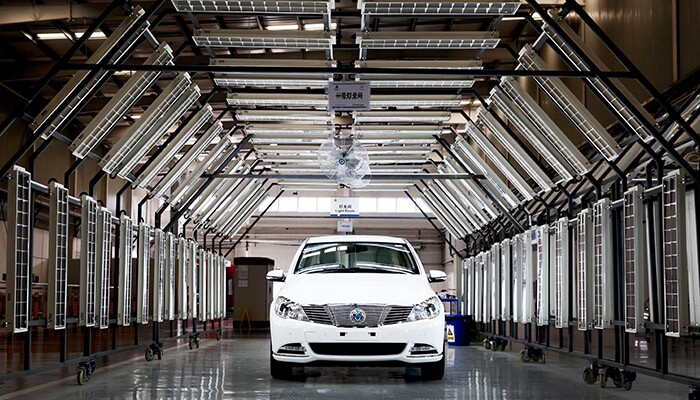
戴姆勒和比亚迪合作的第一款车终于推向市场,但似乎腾势对中国汽车新能源市场并没有足够的信心。
9月26日,腾势首款纯电动汽车率先在上海上市。这距离比亚迪和戴姆勒成立合资公司已经过去了四年。用四年时间来研发生产一款车在中国人眼里看来似乎太长。深圳比亚迪戴姆勒新技术有限公司COO罗格林(Arno Roehringer)告诉界面记者,如果时间允许,他希望用更长的时间来完成这个项目,因为这是一个全新的项目。
腾势的电池容量为47.5千万时,官方续航里程为300公里。为了加强电池组的安全性能,腾势的电池组外包裹着一个电池防护装置,它降低了汽车在发生碰撞时的自燃几率。比亚迪的E6电动车2012年曾在碰撞之后发生大火。
前克莱斯勒东北亚负责人、高风咨询公司董事总经理Bill Russo称,这款车更容易被一些“早期先驱者”购买。
腾势汽车在比亚迪的大本营深圳生产。双方合作中,戴姆勒提供整车制造工艺以及结构安全的品控,比亚迪负责电池、电机、电控和大规模路试。双方将其归结为“技术与品牌”的合作。
腾势为消费者最担心的充电设施做足了准备。腾势与全球电力和自动化技术企业ABB合作,为购车者提供充电解决方案。界面记者获悉,腾势内部还成立了一个专门针对恒大、万科和SOHO这类地产商的游说部门,该部门的主要职责是进行充电设备安装的合作推广。
腾势的首批经销店分别在上海、北京和深圳三个城市,分别由利星行、庞大集团和中升集团代理,他们同时也是奔驰品牌的经销商。
腾势相关负责人称,选择这些城市是因为这些城市出台了地方新能源补贴政策,也是国家节能与新能源示范推广试点城市。南京、杭州等地的经销店则计划在2015年一季度开业。
腾势两款车型售价分别为人民币36.9万和39.9万元。上海、北京和深圳的消费者在享受国家和地方新能源推广补贴后的购买起步车型的价格都不超过30万元,还能享受减免车辆购置税等优惠。
庞大集团董事长庞庆华称,“原计划在9月中旬开业的北京经销店现稍有延迟,目前接到了30多个订单。”未来腾势经销店还提供免费接送的充电服务。
双方的准备似乎非常充分,但戴姆勒对腾势未来的销量持谨慎态度。腾势汽车一份内部规划显示,今年9月产量为115辆,半年后月产量也只有213辆。而腾势工厂的规划产能是4万辆。
原计划去年11月亮相的腾势一直拖延到今年的北京车展,上市之前也没有大的品牌宣传活动,这和比亚迪汽车一贯的处事风格大相径庭。罗格林告诉界面记者,从戴姆勒的角度来讲,他们更注重产品的质量和提供的服务,对于宣传不是特别在意,所以最终按照戴方的意思执行。
Bill Russo认为,中国的电动车市场目前主要受补贴驱动。大规模的营销活动在初期并不是必须的,更重要的是让消费者接受产品本身,让政策制定者通过税收和补贴政策吸引消费者。
“相对于奔驰品牌,腾势是一个全新的品牌和产品,很多事情还在摸索中,”上海利星行腾势经销店的负责人郑雄伟称,虽然有很多热心客户询问,但后续效果如何他们也不得而知。
在中国,德系三大豪华汽车品牌选择了不同的新能源汽车发展道路,这些道路看起来都趋向于保守。稍早上市的华晨宝马之诺电动车选择了“只租不售”模式,奥迪还未在中国市场推出电动车型。今年8月份,德国总理默克尔访华期间曾为德国汽车制造商推广新能源汽车,呼吁统一中德充电标准。
“发展新能源汽车需要时间,需要建立政府部门、汽车公司和基础设施提供者合作的良性生态圈才能让消费者接受。”Bill Russo告诉界面记者,只有消费者认可了,看到这些利益机会时,汽车制造商才更有信心。
Subscribe to:
Posts (Atom)