Showing posts with label Sinotruk. Show all posts

2.23.2015

Competing in the China Truck Market

Gao Feng Insights Report, February 2015
We are pleased to share with you a report titled: Competing in the China Truck Market.
While global brands have enjoyed success in China’s passenger vehicle market, the same cannot be said for the commercial vehicle market. This segment has been dominated by local Chinese manufacturers who have relied on sales to local buyers seeking low-priced equipment. However, we anticipate that several factors will be reshaping the market and competitive landscape in the commercial truck sector, creating a “window of opportunity” in China for participation in what has historically been a predominantly local market.
We believe that market conditions and regulatory challenges will create a need within China’s truck industry to form alliances with foreign partners to secure capabilities which are lacking in the commercial vehicle sector in China. China’s truck manufacturers will need to upgrade their technology to meet demanding new regulations, and will need to improve their service and distribution business practices as the market matures. The changing mix of products towards a higher concentration of line-haul HT, along with anticipated policy changes brought about from China’s intention to reform its State-Owned Enterprises, are driving forces which will alter the landscape of competition in the commercial truck sector.
We welcome your comments and feedback on our report or in general about our firm.  We would be glad to meet you in person to share our data and perspectives in a fuller manner.  Please let us know if you are interested in meeting and discussing directly how we can help you to operationalize these insights.
Thought leadership is core to what Gao Feng does.  We will, from time to time, share with you our latest thinking on business and management, especially as it relates to China and China’s role in the world.
In this paper, we offer our “deeply rooted in China” perspective to the analysis of the impact of each of these developments.
Best Regards,
Dr. Edward Tse
CEO, Gao Feng Advisory Company
edward.tse@gaofengadv.com
Bill Russo
Managing Director, Gao Feng Advisory Company
bill.russo@gaofengadv.com
Tel: +86 10 8557 0676 (Beijing); +852 2588 3554 (Hong Kong); +86 21 5117 5853 (Shanghai)
Gao Feng website: www.gaofengadv.com

10.29.2013

Understanding the Chinese Commercial Vehicle Market

China Car Times, October 28, 2013


Respected China auto analyst Bill Russo gives his five part opinion and outlook on the Chinese commercial vehicle market in this must read report. The Chinese CV world is the polar opposite to the automotive world, consumers base their purchases on best bang for the dollar, nearly all purchases are Chinese brands and foreign brands are the 1% rather than 50+ percent as in the auto industry.

One opening point is extremely note worthy:
Global manufacturers will increasingly be pushed into the luxury “niche”, unless they adjust their business model and develop low-price, as opposed to low-cost products, which are not just “good enough”, but have the right features, durability, more rapid innovation, and lower price to be sold globally. The Chinese market is already highly fragmented, and the pathway to entry for foreign players is not obvious. However, we believe that several market entry options exist as previously noted. MAN’s JV with Sinotruk may be able to crack open the mid-range market in which local OEMs are dominant.

5.06.2013

Competing in the China Truck Market - Leveraging China for the World

by Bill Russo

This is the sixth and final installment in a series on the China Commercial Vehicles market.  


Click here to read the first installment.


Click here to read the second installment.


Click here to read the third installment.


Click here to read the fourth installment.


Click here to read the fifth installment.


We are in the midst of an economic revolution: a shift of the global center of gravity of economic strength towards the east, which is fundamentally reshaping the competitive landscape of numerous industries.  As an economic bellwether, the automotive industry is of great importance to this rebalancing of economic power.   The changes that result from the restructuring underway in the automotive sector are fundamental and irreversible.

After an unprecedented period of economic expansion, the Chinese government began taking measures to shift the economy to a more stable and sustainable pattern going forward.  China is likely to manage the risks associated with this transition with little disruption to the world, the environment, and the fabric of its own society.

By 2020, we anticipate that the commercial HD/MD trucks install base will increase by almost 7 million units to 10.7 million and annual sales will rise to 1.7 million – representing 43% of the global truck market.  With anticipated growth in export sales of Chinese-assembled trucks, it is easy to see how the Chinese market will be the most important market in the world.

It is becoming increasingly urgent for global truck manufacturers to get in the game in China.   The local players will increasingly influence regulatory policies and standards, making it more difficult to enter and compete in the market in the future.   The delay of Euro 4 gives local MDV/HDV manufactures more time to develop their technology, as they retain their enormous cost-advantage compared to European and Japanese high-end OEMs.

While it is legitimate to question whether Chinese companies can assume a leadership role in the transformation of the global commercial truck industry, one simply cannot deny the influence that China has had on industry developments.  The sheer size and growth of the China market will require multinationals to consider reprioritization of their capital plans and resource allocation.   The reallocation of production and supply resources to China has fundamentally changed the cost structure of many industries – which changes the entire competitive pricing game.  China’s government policies and centrally planned economy have supported the creation of the infrastructure needed to stimulate both the supply and demand side of the auto business.

Already, low-cost “good-enough” quality Chinese companies are about to change the global competitive landscape with products that are relevant to the high-growth global emerging markets.  As China automotive players begin to consolidate, they will increase their efficiency, scale and R&D capabilities – making them even more competitive in the future.

Global manufacturers will increasingly be pushed into the luxury “niche”, unless they adjust their business model and develop low-price, as opposed to low-cost products, which are not just “good enough”, but have the right features, durability, more rapid innovation, and lower price to be sold globally.  The Chinese market is already highly fragmented, and the pathway to entry for foreign players is not obvious.  However, we believe that several market entry options exist as previously noted.  MAN’s JV with Sinotruk may be able to crack open the mid-range market in which local OEMs are dominant.

A catalyst is defined as “a person or thing that precipitates an event”.  This is an appropriate characterization of China’s role in the transformation of the global auto industry.  In a globalized world, we will likely find that the transformation of the automotive business model may not be linked to any one company or country.  Instead, leading 21st century companies will be the ones that can quickly adapt to the reality of globalization.

The emergence of China as the largest automobile market in the world is a significant event only in the sense that it causes the entire world to take notice of just how fast this economy is developing – and to also understand precisely how China is transforming the global auto industry.  Rather than trying in vain to turn the clock back to the way things used to be, it would be wise to learn how to use these transformational forces to define a business model to leverage the capabilities which globalization makes possible.


3.31.2013

Competing in the China Truck Market - Winning in China's Mid-Market

April 1, 2013

by Bill Russo

This is the fifth installment in a series on the China Commercial Vehicles market.  


Click here to read the first installment.


Click here to read the second installment.


Click here to read the third installment.


Click here to read the fourth installment.

Most multi-national companies that aspire to be global leaders have no choice but to find a way to win in the Chinese mid-market. 


The common strategies employed by MNCs are to:

  1. Ignore the risk and avoid competing in China’s mid-market altogether.
  2. Offer global products and wait until China catches up to more upscale demand, which works only for a limited number of sectors.
  3. Pursue a two-tier strategy with a core brand sold along with a lower-priced “good enough” brand considered. MAN is following this approach since early 2011 and Daimler trucks are considering it with their partner Foton.


Multinationals simply cannot afford to cede this mid-market to local competitors.  Instead, they must set about organizing themselves to face the emerging Chinese competitors on their own terms – with products that meet Chinese
needs, developed at Chinese cost, and which can then be taken out of China to other markets around the world. They must stop thinking about what it is they can bring to China, and instead start focusing on what China’s mid-market can offer them – what culture and structures they must adopt that will allow them to innovate at a lower cost and to deliver the goods and services that will drive the next round of global growth.

A good example can be found in the construction equipment industry. Caterpillar, which in the 1990s focused on government relationships and selling traditional, high end products to China, shifted focus after the entry of Japanese and Korean competitors in the mid-market segments, and being squeezed by lower-end local players. In the late 2000’s, Caterpillar acquired Shandong Engineering Machinery and formed local R&D centers to expand into lower end market, while optimizing its cost base to compete. Clearly, Caterpillar reasoned, there was a market segment that was here to stay and CAT’s traditional product and business model positioning wasn’t going to be adequate.

In the medical equipment sector, another good example of a mid-market innovation was General Electric’s development of ultrasound machines. From 1990 to 2000, GE served the Chinese ultrasound market with machines developed in the US and Japan, priced at $100K and upwards. While these products were successful with a narrow set of hospitals, the price point was above the affordability threshold of many. In 2002, GE’s local team in China leveraged GE global resources to develop a cheaper, portable machine, priced at $30-40K. And then in 2007, GE’s local, China organization launched a dramatically cheaper model, priced at only $15K. The result of these step-wise innovations in somewhat functionality but at dramatically lower price points, were products that saw rapidly increasing sales in China from $4M in 2002 to $278M in 2008, and at the same time, these mid-market products found new markets abroad. As it turned out, there had been latent demand for lower-priced ultrasound machines even in the world’s most developed markets, but neither GE nor its competitors had realized this or pursued this demand with relevant products.

Mid-market products are not simply lower-cost variants to global, high end products that can be delivered at lower price points.  Foreign and Chinese companies will bring very different mindsets into the battle for the middle market.

Although the competitive strategy to address the middle markets may be different, the path for both Chinese and foreign companies is the same: access the middle market growth opportunity to both extend brands and product reach with the magnitude of impact that can change the global competitive landscape.    
Ultimately, mid-market capabilities rooted in China can be leveraged to tap global markets with similar demand patterns.  

While the size and importance of the Chinese mid-market opportunity may be understood, it is often unclear how Multinationals can participate in the market.  The Chinese market is already highly fragmented, and the pathway to entry for foreign players is not obvious.  However, we believe that several market entry options exist.  It is important to understand that competing in Chinas rapidly expanding and highly competitive mid-market will require an integrated set of capabilities.

For example, MAN SE (Maschinenfabrik Augsburg-Nürnberg), in a joint venture with China’s Sinotruk, has maintained a two-tiered strategy since early 2011.  Vehicles for the Chinese market are sold under the Shandeka brand name, and those for other emerging markets across Asia, Africa, and the Middle East are sold as Sitrak.  This strategy allows MAN to sell two different vehicles at two different price points to two different markets, with separate business models.

In China’s passenger vehicle market, similar two-tiered strategies are increasingly adopted by international OEMs in the form of Joint Venture local brand development.  Starting with the Everus brand launch by Guangzhou Honda in 2010, Shanghai GM Wuling, Dongfeng Nissan, and Dongfeng Honda have each launched their respective JV local brands.  The vehicles carrying those brands are often originally branded vehicles at the end of their life cycle, which are rebranded after certain local adaptations are made to meet the taste of the Chinese consumer.  Such an approach is intended to generate higher volume through upgraded old generation vehicles without diluting the brand image of international players.

The two-tiered strategy, with separate but parallel business models, can be effective:  it enables companies to compete in mid-markets where they otherwise could not.  However, it is not a trivial task for many global producers of industrial equipment to build the capabilities needed to sell effectively to mid-market customers in China.  They must invest in Chinese (or equivalent) R&D and product development, simultaneously integrating their new operations with their old and managing intellectual property challenges. They also lack the home advantages that Chinese mid-market innovators possess: the knowledge of their market niche, access to low-cost production resources, and a deep understanding of the regulatory and operational environment.  Joint ventures such as MAN’s can help, but they also add complexity.

A small number of global companies are focusing on developing an integrated capabilities system that approaches Chinese mid-market customers and Western higher-end customers in an integrated way.  This requires a relentless focus on improving operations and product development together with regional integration.  For example, a company might migrate more parts of its value chain and innovation practices to China and other lower-cost countries — with the intent not of saving labor costs, but of gaining distinctive production and sourcing capabilities that can be put in place around the world. These new efforts can specifically target the country’s mid-market and use local engineers and research staff accustomed to more frugal ways of thinking.  It may not be obvious at first how particular product lines will be affected, but the new efforts can act as springboards for the kinds of ventures that lead to capabilities that can be leveraged around the world[1].


[1] Edward Tse, John Jullens and Bill Russo, “China’s Mid Market Innovators”, Strategy & Business, Summer 2012, Issue 67.


2.03.2013

Dongfeng and Volvo ink tie up for heavy trucks

China Daily, February 4, 2013
Dongfeng and Volvo ink tie up for heavy trucks
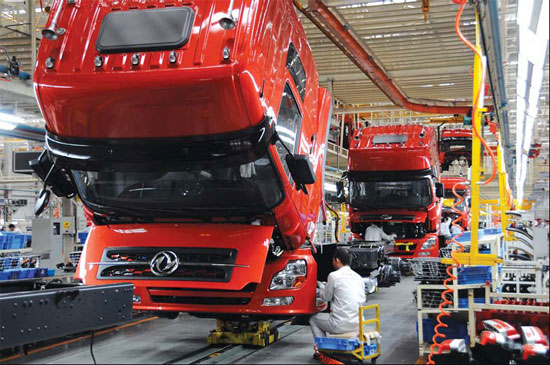
The heavy truck production line at Dongfeng's plant in HubeiAfter a failed attempt with SinotrukVolvo is now partnering with China's second-largest automotive groupPeng Tong / For China Daily


Swedish brand says deal will make it global sales leader
China's Dongfeng Motor Corp and Sweden's AB Volvo recently agreed to form a joint venture to produce medium and heavy-duty trucks carrying the Dongfeng nameplate for sale in both domestic and overseas markets.
According to the agreement, Dongfeng will own 55 percent of the venture, while Volvo will pay about 5.6 billion yuan ($903 million) for a 45 percent stake.
The new venture, Dongfeng Commercial Vehicle Co, will have seven board members, four appointed by the Chinese partner and three by Volvo.
China's second-largest auto group, Dongfeng sold more than 3 million vehicles last year, including more than 205,000 medium and heavy-duty trucks, making it the biggest domestic manufacturer in the segment.
The group's medium and heavy-duty truck unit was previously part of its partnership with Nissan Motor Corp. The large Sino-Japanese joint venture also produces passenger cars and light-duty commercial vehicles.
The recent agreement calls for Dongfeng to buy out Nissan's share in the truck unit and transfer a 45 percent stake to Volvo.
Dongfeng President Zhu Fushou said the "strategic alliance" with Volvo will help the company quickly improve its research and development capability and accelerate its entry onto international markets.
"We will jointly develop new trucks, new engines that can meet the latest emission standards, as well as transmissions, all under the Dongfeng brand," Zhu said.
"Dongfeng and Volvo will share resources in suppliers, manufacturing and international sales to achieve the best synergy," he said.
The company said the new venture will retain the former production facilities in the central province of Hubei, the home base of Dongfeng.
Familiar partners
Volvo and Dongfeng are actually not new partners. They already have a joint venture in Hangzhou, Zhejiang province that makes chassis for big trucks and buses. Dongfeng started the joint venture in the 1990s with Japan's UD Trucks, which was acquired by Volvo in 2007.
Both companies said their cooperation in Hangzhou works well, which led to the "further step" in the latest agreement on trucks.
Still pending government approvals, the transaction is expected to be completed in 12 months, according to a statement from Volvo, which said the partnership will make it the world's biggest heavy-duty truck maker in annual sales.
"With this agreement in place, we take a crucial step toward reaching a number of our key strategic objectives such as size and growth in Asia," said Olof Persson, Volvo's president and CEO.
"China is the world's largest market for heavy trucks, equivalent to the European and North American markets combined," he said.
Market data shows that sales of heavy trucks in China last year totaled about 636,000 units, the lowest number in the past three years.
LMC Automotive forecasts that with more investment likely this year, China's heavy-duty truck sales might see a 10 percent increase to more than 700,000 units. IHS Automotive projects a bounce back this year as well, but by about 6 percent.
In addition to Dongfeng, almost all major truck makers in China have formed joint ventures with foreign partners to improve their technological strength. China National Heavy-duty Truck Corp (Sinotruk) has partnered with MAN, Jianghuai Automobile Co with US company Navistar, and Bejing-based Foton with Daimler.
The new partnership with Volvo will help Dongfeng meet more stringent safety and environmental requirements and differentiate itself in the Chinese market with advanced technology and vehicle features, said Bill Russo, senior advisor of Booz & Co.
Mutual benefit
"More importantly, it gives both Volvo and Dongfeng the opportunity to develop capabilities that are going to be relevant to other markets, not just in China," he said, "There is mutual benefit."
Wayne Xing, veteran industry observer and chief editor of the China Automotive Review, agreed that "it's a good opportunity for both partners".
"Dongfeng needs a partner to achieve its ambition to become the third-largest commercial vehicle maker in the world, and for Volvo, there is no market other than China that can significantly increase its sales and profit," he said.
One of the world's leading truck makers, Volvo has been longing to participate in the vast Chinese market, yet its effort with Sinotruck was unsuccessful.
The joint venture established in 2003 made Volvo trucks, which proved to be too expensive for the market to accept. It was dissolved in 2009 following sluggish sales and disagreements over management.
After its painful experience with Sinotruk, Volvo has changed its strategy with the new joint venture to adapt to the Chinese market. In the new venture, Volvo agrees to take a minority share and produce local brand vehicles.
"They (Volvo) did learn that it's always difficult to control a partnership of any kind whether in China or anywhere else," said Russo at Booz & Co.
The company has also learned that trying to produce a Volvo truck for China is "not realistic from a market standpoint," he said.
Roman Mathyssek, head of global truck research and advisory at IHS Automotive, said that after the first joint venture, "Volvo will be more patient with Dongfeng, and it will need to understand that Dongfeng has an interest to expand to other markets as well".
"In our view, the most critical element for the long-term success of the venture will be how the two companies plan to divide the sales and responsibilities in other emerging markets," he noted.