11.14.2012

WTO Intervenes in U.S. Pushback Against China Tariffs

Ward's Auto, November 12, 2012

Click here to read the article at wardsauto.com

An analyst says the duties are meant to keep imports of “posh” Western vehicles at bay while China moves beyond small-car production and develops midsize and large cars.


A new trade dispute at the World Trade Organization between the U.S. and China over protective duties could foreshadow a battle in a long war for supremacy in global auto markets, an industry expert says.
Peter Cooke, a professor of automotive management at the University of Buckingham in the U.K., discusses the scenario after the WTO’s disputes-settlement body established a panel to adjudicate claims China is imposing illegal duties on U.S. vehicles exported to the country.
Cooke predicts a tough fight from Beijing to maintain the duties, which he characterizes as both punishing and strategic.
According to the U.S. Trade Representative (USTR) office, the Chinese government in December 2011 issued both anti-dumping and countervailing tariffs on U.S.-built cars and SUVs with engine capacity of 2.5L or larger.
The USTR reports the anti-dumping duties are 21.5%, with lower rates for selected car companies ranging from 2% to 8.9%, and countervailing tariffs of 12.9%, with lower rates from between 6.2% and 12.9%. These are paid on top of China’s existing 25% duties on U.S. auto imports.
Cooke tells WardsAuto.com China is playing a “long game” with the aim of giving its auto sector time to develop midsize- and large-car capacity, building from its existing strength in the small- and budget-car sector.
“This is part of the new protectionism” spurred by China’s assessment of its local market, he says.
“Driving largely Western cars cannot be good for the pride of China – what about their own domestic brands?” the analyst says. In a market in which “posh” cars are imported, “the buyers love it, but if you are the government, you won’t.”
Chinese leaders “are flexing their industrial muscles, and they are looking at what is one of the most profitable sectors of the market and (saying), ‘We want some of that.’”
The analyst adds that China’s recent economic slowdown likely will make Beijing’s newly appointed political leaders more aggressive in fighting the WTO case.
The duties China is defending are intended to compensate domestic auto makers for alleged U.S. government subsidies to American car companies, and to punish those manufacturers for alleged dumping in China – selling at reduced prices cars that are more expensive at home.
Both practices could violate WTO rules. The panel will decide whether China’s claims are valid and, if so, whether they are in fact illegal.
The U.S. government is confident it will win the case. American diplomats fired a broadside at their Chinese counterparts during an Oct. 22 meeting in Geneva of the WTO dispute-settlement body that formed the panel to judge the countries’ conflicting claims.
Noting attempts to resolve the dispute through negotiations held with China since July have been unsuccessful, a U.S. statement claims China has “breached a number of its obligations under the (WTO) General Agreement on Tariffs and Trade, the antidumping agreement and the subsidies agreement.”
Several Chinese auto analysts contacted by WardsAuto suggest the U.S. move against China’s measures was timed to make President Obama appear tough on China during the run-up to his re-election.
They also suggest China’s tough stance at least is partly motivated by wanting to counter U.S. complaints to the WTO about Chinese promotion of exports such as clothing. The U.S. already has raised concerns about Chinese tire-import controls.
China’s higher duties are a way of “rattling the saber” over sales of U.S.-built SUVs in the country, says Bill Russo, senior adviser at global consulting firm Booz & Company’s Beijing office.
The tariffs “generally do not have a widespread impact for manufacturers who have production capacity to make cars in China,” he says. The effect is greater on “those who are importing vehicles…This may selectively target car makers like Chrysler who no longer produce vehicles in China.”
Russo also says the levies may be meant to “weaken premium brands of General Motorsand Ford (Cadillac and Lincoln, respectively) which are exported to China.”
While GM stands to gain if the WTO panel rules against China, the auto maker already has been prospering from its manufacturing operations in the country.
According to the China Association of Automobile Manufacturers, GM says imported vehicles account for less than 0.5% of its Chinese sales. 
Other U.S. auto makers also could benefit if America prevails in the tariff dispute and ultimately convinces China that freer trade is in everyone’s interests, predicts Tomas Hult, director of the International Business Center at Michigan State University.
He argues if China abolished its existing duties and harmonized its tariffs with the U.S. at 2.5%, then GM alone could sell 9 million cars a year in China, up from 2.5 million today.
“With the exception of the last year, the Chinese auto market has grown tremendously in the last decade, mainly due to the population growth of China’s middle class,” he says.
– with Leah Germain and Mark Gao in Beijing

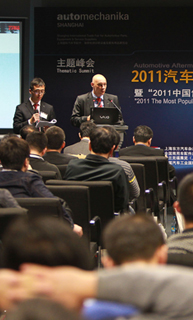
Bill Russo Moderates Panel Discussion at China Automobile Dealers Association Annual Conference

Suzhou, China, November 30, 2012


Topic:


互动沙龙:分享国外经销商与厂商及法律法规的关系及创新的收入模式
Share international experience regarding innovative dealer revenue models and OEM relationship

Moderator 主持人: Bill RussoFounder and President, Synergistics Limited 
and Senior Advisor, Booz & Company, United States   


Panel members: 互动嘉宾
  • Leonardo Buzzavo, President, Quintegia 欧洲经销商大会组委会总裁
  • Steve Wilhite, former SVP Global - Marketing Nissan 前日产全球高级副总裁
  • Patrick Tessier, Australian ADA Convention 澳大利亚经销商大会总裁
  • Bruce Bendell, Chairman and CEO, Major Automotive Companies, USA

11.11.2012

Bill Russo to Speak on Green Mobility at NextGen Auto International SUmmit China

Shanghai, China, December 11-13, 2012


Messe Frankfurt’s premiere auto industry gathering, NextGen Auto International Summit China, is designed as a truly international thought leadership platform for speakers and delegates to interact, exchange ideas and promote new strategies, collaborations, technologies, services and applications.
Delegates will take away new insights into business development directions and technology innovations that can facilitate a more sustainable and profitable future for OEMs, suppliers and service providers.

High-level contributing speakers include:
Bill RUSSO, President and CEO, Synergistics; Senior Advisor, Booz & Co., China
As a former Chrysler executive in the China and Asia markets, Mr. Russo’s experience has involved successful partnership negotiation agreements, bringing new vehicle programs to market, and establishing sales / distribution infrastructure. He will share his insights on creating a green transportation paradigm for 21st century mobility in China.
Bill
Mats
Mats HARBORN, Executive Director, Scania China Strategic Center, China
Drawing on his China experience as China Board Member of the European Automobile Manufacturers Association (ACEA), and representing Scania’s operations in China, Mr. Harborn will explore the way forward to greener, cleaner, energy efficient and more productive commercial fleets.
Dr. Gang XU, Partner, PwC’s PRTM Management Consulting, China
Drawing on his extensive automotive experience with Ford Motor, A.T. Kearney and PRTM, Dr. Xu will explore product innovation, platforming, new manufacturing approaches and supply chain needs for the next generation of passenger and commercial vehicles.
gang
Hiroyuki
Hiroyuki AOKI, Senior Manager, Mobility Technology Group, TEPCO, Japan
Representing TEPCO, initiator of CHAdeMO and rapid charging, Mr. Aoki will highlight plans for the roll-out of infrastructure as well as the future direction of electric mobility for a low carbon economy in Japan.
Klaus PAUR, Global Head of Automotive, Ipsos, China
Mr. Paur is a consumer marketing, advertising and branding specialist in global automotive markets. He will share his insights on telematics, including connectivity needs, consumers’ willingness to pay, as well as its relevance to the consumers purchasing decision of a vehicle.
Klaus
Allan LARSSON, Vice Chairman and Project Manager, ElBil2020, Sweden
ElBil2020 is a key development project in Stockholm reflecting Sweden’s goal to be a world leader / role model in fossil-fuel free transportation by 2020. Mr. Larsson will detail plans and progress in engaging the whole community for the transition. He is Chairman of the Board of Lund University and a Former Swedish Minister of Finance.
Dr. Tiezheng LI, Automotive Sector Engagement Manager for McKinsey & Co., China
Bringing together substantial industry expertise gained serving in both multinational and Chinese companies with a focus on automotive and energy sectors, Dr. Li will explore the way forward for the electrification of China’s auto industry.
Dr. Anthony THOMSON, Vice President, Qualcomm Europe, UK
Dr. Thomson was founding Chief Executive of HaloIPT (Auckland University’s wireless power initiative) prior to its acquisition by Qualcomm. He will evaluate the global potential for wireless charging infrastructure and innovative applications.
Rick LONGOBART, Fleet, Facilities, and Stores Manager, City of Santa Ana, USA
Recognised as “Fleet Manager of The Year” and representing one of the US Top 100 Fleets, Mr. Longobart has dedicated his career to the quest for safer and greener fleets. He will explain how the telematics services revolution is benefiting municipal governments through carbon footprint reduction, cost efficiencies and increased productivity.
Christian HEEP, Director, Federal Association for eMobility (BEM), Germany
Mr. Heep constantly seeks new ideas and projects to establish electric mobility supported by renewable energy initiatives. He will explore prospects for the electro-mobility transformation under way in Germany and supporting infrastructure initiatives.
Towards the next generation of smart, connected and energy efficient vehicles: Business and technology strategies for success
Who you will meet
Choose from 2 keynote sessions and 9 in-depth tracks covering:
1.Policies, plans and priorities for China’s automotive industry development
2.Adopting new business models and technology innovations
3.Personal mobility and intelligent transportation
4.Commercial vehicles and fleets
5.Connected vehicle technologies and telematics
6.Investment, financing and going global
7.Charging and infrastructure
8.Alternative green fuels and natural gas engines
9.Batteries, energy storage and management solutions
10.Powertrains, regenerative systems and electronic control systems
11.Advanced materials and manufacturing for the next generation
linkView Agenda here. Sessions are bookable separately or as a package.
Save with advance registration: Book before
30th September for discounted delegate fee

Register on or before 30th September 2012 to qualify for up to a RMB1,000 / USD150+ discount on the summit registration fee. Payment is required to secure the discount.

For more details and registration, please click here or scan the QR code below:
qrcode


Russo PresentationTitle: Towards A Green Automotive Industry 


Abstract

As the balance of world market and economic power shifts from West to East, China has emerged as the key location in the battle for dominance of the 21st century’s global auto industry. Due to increasing pressure from air pollution, oil consumption and urban congestion, the focus of the country’s auto industry will increasingly switch from internal combustion driven vehicles to alternative propulsion technologies, particularly those powered by electricity. Already many observers believe that the government’s ambitious series of programs and policies designed to accelerate the development of new energy vehicles run over the last decade will lead to the emergence of China as the key location for a global “green” mobility revolution. As this happens, the eventual electrification of the automotive powertrain will transform the automotive industry, and even society itself.

However, these efforts to reinvent transportation will take longer than widely anticipated. Efforts to leapfrog internal combustion engine technologies or to otherwise short-cycle the development of new and advanced mobility technologies will fall short in the short to medium term. Instead, China’s automotive industry will take a longer, more circuitous route towards its objective of finding new energy replacements for gasoline. The government will be a key player in this through its decisions on where resources and research efforts should be directed, what standards should be mandated, and what subsidies and incentives such as tax breaks should be offered. Transformation will occur in stages, with commercial vehicles such as taxi fleets, delivery companies and bus services being the first major users. As this happens, the industry will see the emergence of new business “ecosystems” - ones that bring together a different range of companies from those traditionally involved in the auto sector. These new forms of collaborative partnerships will in turn lead to new business models, very different from those formed in the era of the internal combustion engine.

Key Words: Electric Vehicles, New Energy Vehicles, Hybrid Vehicles, China, Automotive 

Biography

Bill Russo is the Founder and President of Synergistics Limited and a Senior Advisor with Booz & Company. With over 15 years as an automotive executive with Chrysler, including over 8 years of experience in China and Asia, Mr. Russo has worked with numerous global firms in the formulation and implementation of their globalization strategies. His experience in China includes having successfully negotiated agreements with partners and obtained required approvals from the China government to bring 6 new vehicle programs to the market in a 3-year period, as well as establishing an infrastructure for localization and sales/distribution. Mr. Russo has a Bachelor of Science in Chemical Engineering from Columbia University in New York, and a Master of Science in Manufacturing Systems Engineering from Lehigh University in Bethlehem, Pennsylvania. He is a highly sought after opinion leader on the development of the automotive industry and the electrification of transportation. 

Link to Bill Russo's presentation:

11.05.2012

Chinese automaker BYD Tries to Innovate

CKGSB Knowledge, November 5, 2012


TAKING THE HARD ROAD


Chinese car maker BYD is finding it tough to shift from imitation to innovation.

It used to take a cheeky sense of pride in copying, then beating much bigger rivals. Low costs and imitation made BYD one of China’s top five carmakers in an incredibly short space of time, even inviting a high-profile $232-million investment from Warren Buffett. Since its attempt to move up the value chain, however, the Shenzhen-based automaker, noted for its ‘shanzhai’ or copycat versions of better-known marques, has been having a rough time.

First applied to cheap imitations of brand name cell phones produced in southern China, the term ‘shanzhai’ has now come to denote an inexpensive – and often poor quality – copy. BYD’s efforts to drop the shanzhai label lay in tatters after a fatal accident in Shenzhen in May this year which saw a BYD E6 go up in flames after colliding with a Nissan sports car. The explosion of the E6 was particularly bad news given that it was BYD’s flagship car in the electric vehicle market.

BYD once promoted itself as a global leader in e-vehicle technology and only three years ago made claims that it would be the biggest car company in the world by 2025. Company exports chief, Henry Li, was quoted earlier this year as saying BYD’s electric vehicle platform is “one of the most advanced in the world.” Despite this, the firm is now struggling to compete with other domestic Chinese car companies, let alone the international car brands it would face in developed markets.

BYD’s stock price has dropped 80% from its 2009 high, and 40% since April 2012, while the commercial release of its electric cars has been pushed further down the road.

Shifting Up a Gear

BYD’s problems are in many ways linked to its efforts to move upmarket, from imitation to innovation and higher-margin vehicles. Like many other Chinese low-end manufacturers, BYD has responded to rapidly rising costs by trying to develop a respected brand which will allow the firm to expand its margins, and market share. “You have to acquire capabilities to differentiate your brand, otherwise you’re going to be fighting a commodity battle at a low price point,” argues Bill Russo, a Senior Advisor at Booz & Co, a management consulting firm. “Chinese car companies are in a war of attrition and only the strong will survive.”

BYD began its operations in Shenzhen, producing cell phone batteries at 30% of the cost of competitors like Sony and Sanyo. Like many shanzhai operators, BYD at first largely eschewed machines in favor of an army of workers: as of 2011, the company had 178,000 employees in both its automotive and battery businesses. Ford Motor Company, by contrast, had 164,000 employees globally achieving five times the auto sales recorded by BYD.

Controversially, BYD in its earlier years was known for reverse engineering everything its competitors made, in an effort to learn the technology and see if they could figure out how to do the same thing cheaper. BYD’s bestselling car, the F3, is similar enough to the Toyota Corolla that it can use parts for the latter but sells at half the price. “A core competency of BYD is that they are more willing and more aggressive in copycatting some of the bestselling models globally,” says Teng Bingsheng, Associate Dean and Associate Professor of Strategic Management at the Cheung Kong Graduate School of Business (CKGSB). “You can call it a core competency because they have been very good at it.”

BYD didn’t, however, necessarily eat into the market share of the Toyotas it copied. BYD cars may look like Toyotas but on the road the F3 doesn’t match the performance of the car it imitates. “An automobile has some of the most complex engineering of any consumer product,” says Russo. “You can copy the hardware, but not the soft stuff. Two cars with the exact same hardware can perform completely differently on the road.”

Russo argues that this is why Toyota, unlike BYD’s competitors in the battery industry, has not bothered to take legal action against BYD. Learning from imitating your competitors is something done everywhere, particularly as countries develop their markets. But there it doesn’t have to be a negative for the company being copied. “In China, people buying Toyota Camrys are not cross-shopping with the F6 [another BYD imitation],” says Russo “There is some gray area here. It isn’t necessarily hurting the companies who are having their goods copied and it could improve their brand.”

Shanzhai Successes

BYD’s shanzhai-style imitations of Toyota didn’t take the company beyond the cut-throat, low-price segment of China’s auto market. There are, however, solid examples of shanzhai players taking market share from competitors they’ve copied, particularly in the handset market where shanzhai-style upstarts make phones for a low-income but trend-savvy market. Among the most notorious examples, the Shenzhen-manufactured GooApple handset looks uncannily like the iPhone 4 but runs Android 2.2 system, and retails at RMB 1,060 compared to the RMB 4,000-price tag of the iPhone 4.

Navigating its way upmarket out of the shanzhai space, phone maker Tianyu started out making cheap knockoffs of trendy handsets but has since invested heavily in 3G products. Tianyu’s cheap-chic approach helped it leapfrog Lenovo and nip at the heels of leading players like Nokia and Samsung in terms of handset sales. Selling under the K-Touch brand name, Tianyu showed its intent for export sales when it showed its Android handset at this year’s Mobile World Congress.  “Today, Tianyu is a mainstream player virtually unrecognizable from its shanzhai beginning thanks largely to increased efforts in R&D and brand building,” says a Booz and Co. report titled Shanzhai a Chinese Phenomenon’.
Other winners in the shanzhai economy include QQ, originally a shanzhai version of ICQ, which now commands 75% of China’s online instant-messaging market according to data for 2011 published by iResearch, a consultancy. Future Cola meanwhile has gone from copying Pepsi and Coca Cola (whose red-white packaging livery it most resembles) to become the third-largest player in the local carbonated soft drinks market, just behind Pepsi according to 2011 data published by Euromonitor.

A More Orthodox Approach

Forced by competition and rising costs to target higher-value and global markets, BYD has had to change the design of a number of its cars, including the F3, in order to avoid lawsuits overseas. “We are working to develop a unique brand identity as we grow to meet our customers’ demands,” says Sherry Li, a representative for the company. “We are very proud of our design evolutions.” But with the design changes, BYD lost market share and the F3 is now the 24th best seller inChina, down from first a few years earlier. In the first six months of 2012, sales of the F3 dropped 40%, a sales decline larger than any other car in the top 50.

BYD may have to wait some time to regain sales momentum as it moves from the shanzhai model in search of higher margins. BYD is following much the same path taken by another privately-owned Chinese carmaker Geely (lambasted by the global auto press for its Geely GE, a cheeky imitation of Rolls Royce’s iconic Phantom, among others), which has looked to foreign companies to bring in expertise. In 2007, the company opened a joint venture with Manganese Bronze Holdings, which manufactures London black taxis. The joint venture led to the development of the Englon, Geely’s mid-range model, and the company is in talks with the UK government to electrify the London taxi fleet. In 2009, Geely acquired Drivetrain Systems International, a global transmission developer, and finally in 2010, bought the Volvo brand from Ford, bringing access to global markets with it.

By slowly building capacity and knowhow, Geely has been able to gain high-value and high-margin customers. “It took the better part of 10 years to get where they are today, but it is paying off in terms of how their brands are performing,” says Russo.

BYD is slowly coming around to the same approach, in part by entering into a 50:50 partnership with Daimler-Mercedes. The partnership is mostly focused on electric vehicles, but according to BYD spokesperson Li, it is affecting other parts of the business as well. “BYD’s partnership with Daimler-Mercedes relocated over 100 engineers and quality professionals to BYD headquarters,” she says. “We have acknowledged many improvements in our design and production processes with the help of our partners.” Experts feel that more such partnerships will be the only way that BYD can catch up to its competitors.

“BYD [needs] partnerships so they can be technologically competitive,” says CKGSB’s Teng. “State-owned car companies have been doing this for 30 years, so they have an advantage in the mid- and high-level [market]. But even in the lower-end, companies are finding they need competitive advantages.”

The company is no longer claiming it will reach market-leading status in the next decade, but rather it is reaching “foreign-OEM brand quality”, according to Sherry Li. In other words, they are catching up with two of China’s ‘Big Four’ automakers, SAIC and FAW, and are still a long way off from the Japanese, Korean and American brands the firm once gleefully imitated.

This new modesty has turned into concrete business development. The company is developing its own drivetrain system, as well as mechanizing much of its production line, which, according to Chinese media reports, previously had error rates of 20-30%.

Electric Options

Unlike many other brands with a shanzhai past, BYD has an ace to play if it can retain a reputation for innovation in electric vehicles. BYD is a household name now, both within and outside of China, and much of that has to do with their electric vehicle business, even though it’s not been doing very well.

“The company barely sells any electric vehicles, but it gives their company the aura of a high-tech company,” says Han Xiong, automotive editor at the Guangzhou-based Yangcheng Evening News and a popular blogger on China’s auto market.

This strong brand is an incredibly valuable asset to BYD. “Chinese companies need to develop capacities that improve the image of their brand,” says Russo. “The worst thing is to have technology that you can’t price.” But BYD “over-promised and under-delivered”, he adds.

Having come up with the concept for the world’s first mass-produced, plug-in hybrid vehicle (three years before the GM Volt), the F3DM–BYD’s fully electric car–came out in China two years behind schedule, and it still faces delays with its planned US release. The company and analysts are in disagreement as to how much of the delay was due to a shortage of related infrastructure, versus deficiencies in the engineering, and safety concerns.

Industry analysts were bullish about BYD because of its background in battery making, giving it a possible edge in the electric car business. In 2008 Warren Buffett took a 10% stake in BYD for $230 million, praising the firm’s battery technology and its role as a leading player in electric vehicles.

Proving a reputation for innovation may restore BYD’s fortunes. In the meantime, other one-time shanzhai operators may also be making the move from imitation to innovation. Booz and Co.’s ‘2012 China Innovation Survey: Innovation – China’s Next Advantage?’  shows that 45% of multinationals active in five sectors in China reported that Chinese peers were equally or more innovative than themselves. Chinese firms (38% compared to 30% of MNCs) are “need seekers” – firms that research their customers’ needs and design products accordingly. While 53% of Chinese firms said they’re collaborating with foreign partners on R&D another 40% said they’re pursuing their own R&D.

By tailoring products quickly to local needs and pockets – and then investing in R&D and marketing–the shanzhai path pursued by Tianyu and BYD is largely similar. However the future of that model is now uncertain as government leans on IPR infringers, through more aggressive prosecution of offenders, to encourage innovation. Competition in the domestic market and ambitions to export will force more Chinese manufacturers to make a choice similar to the one faced by BYD and Tianyu.

Nonetheless, there will be space for low-cost imitators in China’s vast lower-income markets. While labor costs have risen, the key factor in the success of the shanzhai model–China’s manufacturing capacity–remains intact. Shanzhai handset makers, for instance, are still churning out new models in Shenzhen, leveraging an ecosystem of 30,000 highly specialized companies which collaborate across the entire mobile phone value chain from design to sourcing, production and distribution.

Facing possibly the toughest period in its short history, BYD has a chance to redeem itself and emerge as a serious global player, if it can prove its abilities to innovate in electric vehicles. That will be difficult. Russo warns that, if anything, Chinese companies are at a disadvantage to foreign companies when developing electric vehicles because they lack the deep engineering experience that comes with decades in the business. “Whether or not BYD can develop feasible battery technology, that is the most critical issue here,” say Teng. “So far it has been much more difficult than expected.”

Shanzhai companies have boomed in China on the back of innovative cost-cutting and aggressive business models, but there is still a substantial need for outside experience for companies wanting to go global. Copying can bring you to the technological frontier, but pushing past it requires hard-won experience. It’s the sort of thing BYD needs a lot of, fast.

Photo courtesy: Flickr @jerryluo0520′s photostream

http://knowledge.ckgsb.edu.cn/2012/11/05/china-business-strategy/taking-the-hard-road/