2.04.2013

Competing in the China Truck Market - Policy & Regulatory Outlook

February 5, 2013

by Bill Russo


This is the third installment in a series on the China Commercial Vehicles market.  

Click here to read the first installment.

Click here to read the second installment.


Government policy plays leading role in driving the development and eventual consolidation of China’s auto industry. According to the Plan on Adjusting and Revitalizing the Auto Industry promulgated in the early of 2009, “capable Chinese players are encouraged to grow stronger by M&A and restructure”. 

The plan outlines an intention to consolidate the industry into 2 distinct “tiers”:  the Tier 1 group consisting of companies with an annual capacity of 2 million units that are encouraged to acquire smaller automotive companies throughout China, whereas Tier 2 consists of companies with an annual capacity of 1 million units are encouraged to drive regional consolidation. 

The plan even names four tier 1 companies as well as four tier 2 companies:

  • TIER 1: 
    • Shanghai Automotive Industrial Corp (SAIC)
    • First Auto Works (FAW) Group
    • Dongfeng Motors (DFM)
    • Chang’An Automotive

  • TIER 2
    • Beijing Automotive Industrial Corp (BAIC)
    • Guangzhou Automotive Industrial Group (GAIG)
    • Chery Automobile
    • China National Heavy Duty Truck Corp (CNHTC)


The top 3 HDT manufacturers including FAW, DFM and CNHTC are among the Tier 1 and 2 OEM groups named within this consolidation plan, and are therefore likely to receive extra funding and policy support from the central government when acquiring smaller companies.

Responding to the government policy indication, leading auto groups are actively establishing their growth strategies and seeking to build scale advantage.  Among them FAW, DFM, BAIC, SAIC, and CNHTC are more likely to be acquirers in industry consolidation among the HDT/MDT players.


The early stages of industry consolidation have already begun.  Starting from its acquisition of Nanjing Auto Group in 2007, SAIC has expanded their production bases from Shanghai to Yizheng and Nanjing in Jiangsu province.  FAW is negotiating with Brilliance on business restructuring and acquisition.  If the deal is done, FAW will grow larger than SAIC in terms of scale.  After acquiring Changhe and Hafei, the Chang’An Automotive group possesses nine manufacturing bases across the country.  The company also stated their plans to merge two to three domestic vehicle companies and one parts company within their next 5-year plan.

To defend themselves and avoid being acquired, smaller commercial vehicle companies like JAC, Beiben and others are actively expanding their business coverage, developing special sectors, and establishing product technology cooperation.

For global truck manufacturers, the consolidation of the China auto industry implies that a more structured and disciplined market will eventually emerge which will increase the efficiency, scale and R&D capabilities of the remaining competitors.  Leading Chinese OEMs will seek to expand their ownership of assets and capabilities needed to compete in an increasingly global business. 


Chinese OEMs must therefore move up the value chain to deliver products with competitive technology to address a growing demand generated for world-class quality trucks.  To achieve this, they will undoubtedly allocate larger investments into product development, enabling better responsiveness to the market.  Further, the industry will require better IP protection and enforcement to facilitate technology sharing with international players.


Though industry consolidation will likely be a central theme in the next decade, there are several other policy and regulatory trends that pose challenges to the global truck manufacturers in China.  

First, the China government is closing the gate for international newcomers by raising the entry barrier for new project approval.  Automotive industry policy makers have strong concerns with overcapacity risks in the China auto industry.  These concerns are having an impact on their willingness to consider new vehicle manufacturing projects including HDT.  Therefore, Ministry of Industry and Information Technology (MIIT) released the Admission Management Rule for Commercial Vehicle Enterprises and Products, which took effect from January 1st, 2011, requiring all truck manufacturers to strictly follow current investment and capacity utilization requirements. Despite this, other very challenging policy objectives must also be met, including the upgrading of the technology used in the local brands, new energy vehicle development and export promotion.  Global manufacturers who are willing to share critical technology and capabilities with their Chinese partner may be able to successfully receive approval for their new manufacturing project in China.


Second, although Chinese policy makers stress their serious attention to the subject, Intellectual Property (IP) protection is an area of great uncertainty for global manufacturers.  Global vehicle manufacturers are pushed to transfer their leading technologies in a market where the legislation and law enforcement for IP rights violations is far from sufficient.  Many IP related lawsuits claimed by international manufacturers in China have not been met with satisfactory results, such as BMW’s compliant for Hubei Shuanghuan’s styling imitation of X5, Fiat’s claim for Great Wall’s copy of Panda, as well as GM’s claim for Chery’s copy of the Chevrolet Spark.  Such issues also extend into areas of technology and other transfer of capabilities.  Learning from past experiences, many international manufacturers have taken both technical and commercial measures to protect their IP when cooperating with Chinese partners.  For instance, a modular sourcing strategy from Tier 1 suppliers can be employed (instead of sourcing individual component through the Joint Venture) has become a common practice to protect IPR of the multinational partner.

Third, global truck manufacturers will increasingly face China unique standards, which are influenced by the local players.  Global truck manufacturers who have made significant commitments to the market often feel like a “guest in their own house” when doing business in China.  For instance, the delay of Euro 4 gives local MDT/HDT manufacturers more time to develop their technology, as they retain their enormous cost-advantage compared to foreign high-end OEMs. Similar advantage for Local MDT/HDT manufacturers is the current end-of-life regulation, which requires scrapping after 600,000 km. Such developments might be influenced by politics.  To mitigate risk of such unfavorable standard, global truck manufacturers have to make proactive efforts in involving and lobbying the organizations that develop regulations. The resources and experience of the Chinese partner in dealing with the policy-makers are also essential to be leveraged to address this challenge.

Finally, global truck manufacturers will be exposed to legal compliance risks when working with their Chinese joint venture or affiliated company.  In spite of measures taken to address the problem, bribery and other corrupt business practices are common in China.  Several years ago, individuals within the Daimler Truck division were implicated in an anti-bribery case in China.  Daimler was required to pay as much as USD $185Mn for reconciliation, and the company has been compelled to reinforce corporate compliance in every process of the business operation.  Corrective actions such as establishment of a regional compliance office, compliance-related business processes, mandatory compliance training, and a hotline to report violations of compliance behavior have turned out to be highly effective in mitigating the compliance risk for Daimler in China.

2.03.2013

Dongfeng and Volvo ink tie up for heavy trucks

China Daily, February 4, 2013
Dongfeng and Volvo ink tie up for heavy trucks
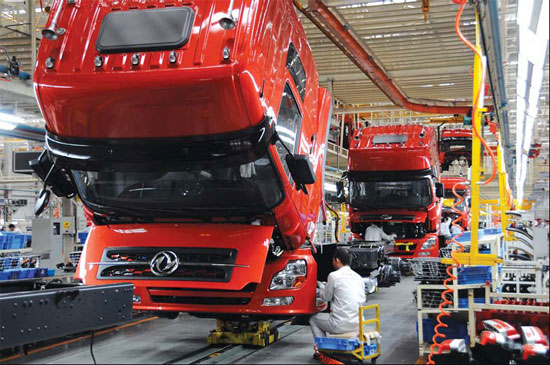
The heavy truck production line at Dongfeng's plant in HubeiAfter a failed attempt with SinotrukVolvo is now partnering with China's second-largest automotive groupPeng Tong / For China Daily


Swedish brand says deal will make it global sales leader
China's Dongfeng Motor Corp and Sweden's AB Volvo recently agreed to form a joint venture to produce medium and heavy-duty trucks carrying the Dongfeng nameplate for sale in both domestic and overseas markets.
According to the agreement, Dongfeng will own 55 percent of the venture, while Volvo will pay about 5.6 billion yuan ($903 million) for a 45 percent stake.
The new venture, Dongfeng Commercial Vehicle Co, will have seven board members, four appointed by the Chinese partner and three by Volvo.
China's second-largest auto group, Dongfeng sold more than 3 million vehicles last year, including more than 205,000 medium and heavy-duty trucks, making it the biggest domestic manufacturer in the segment.
The group's medium and heavy-duty truck unit was previously part of its partnership with Nissan Motor Corp. The large Sino-Japanese joint venture also produces passenger cars and light-duty commercial vehicles.
The recent agreement calls for Dongfeng to buy out Nissan's share in the truck unit and transfer a 45 percent stake to Volvo.
Dongfeng President Zhu Fushou said the "strategic alliance" with Volvo will help the company quickly improve its research and development capability and accelerate its entry onto international markets.
"We will jointly develop new trucks, new engines that can meet the latest emission standards, as well as transmissions, all under the Dongfeng brand," Zhu said.
"Dongfeng and Volvo will share resources in suppliers, manufacturing and international sales to achieve the best synergy," he said.
The company said the new venture will retain the former production facilities in the central province of Hubei, the home base of Dongfeng.
Familiar partners
Volvo and Dongfeng are actually not new partners. They already have a joint venture in Hangzhou, Zhejiang province that makes chassis for big trucks and buses. Dongfeng started the joint venture in the 1990s with Japan's UD Trucks, which was acquired by Volvo in 2007.
Both companies said their cooperation in Hangzhou works well, which led to the "further step" in the latest agreement on trucks.
Still pending government approvals, the transaction is expected to be completed in 12 months, according to a statement from Volvo, which said the partnership will make it the world's biggest heavy-duty truck maker in annual sales.
"With this agreement in place, we take a crucial step toward reaching a number of our key strategic objectives such as size and growth in Asia," said Olof Persson, Volvo's president and CEO.
"China is the world's largest market for heavy trucks, equivalent to the European and North American markets combined," he said.
Market data shows that sales of heavy trucks in China last year totaled about 636,000 units, the lowest number in the past three years.
LMC Automotive forecasts that with more investment likely this year, China's heavy-duty truck sales might see a 10 percent increase to more than 700,000 units. IHS Automotive projects a bounce back this year as well, but by about 6 percent.
In addition to Dongfeng, almost all major truck makers in China have formed joint ventures with foreign partners to improve their technological strength. China National Heavy-duty Truck Corp (Sinotruk) has partnered with MAN, Jianghuai Automobile Co with US company Navistar, and Bejing-based Foton with Daimler.
The new partnership with Volvo will help Dongfeng meet more stringent safety and environmental requirements and differentiate itself in the Chinese market with advanced technology and vehicle features, said Bill Russo, senior advisor of Booz & Co.
Mutual benefit
"More importantly, it gives both Volvo and Dongfeng the opportunity to develop capabilities that are going to be relevant to other markets, not just in China," he said, "There is mutual benefit."
Wayne Xing, veteran industry observer and chief editor of the China Automotive Review, agreed that "it's a good opportunity for both partners".
"Dongfeng needs a partner to achieve its ambition to become the third-largest commercial vehicle maker in the world, and for Volvo, there is no market other than China that can significantly increase its sales and profit," he said.
One of the world's leading truck makers, Volvo has been longing to participate in the vast Chinese market, yet its effort with Sinotruck was unsuccessful.
The joint venture established in 2003 made Volvo trucks, which proved to be too expensive for the market to accept. It was dissolved in 2009 following sluggish sales and disagreements over management.
After its painful experience with Sinotruk, Volvo has changed its strategy with the new joint venture to adapt to the Chinese market. In the new venture, Volvo agrees to take a minority share and produce local brand vehicles.
"They (Volvo) did learn that it's always difficult to control a partnership of any kind whether in China or anywhere else," said Russo at Booz & Co.
The company has also learned that trying to produce a Volvo truck for China is "not realistic from a market standpoint," he said.
Roman Mathyssek, head of global truck research and advisory at IHS Automotive, said that after the first joint venture, "Volvo will be more patient with Dongfeng, and it will need to understand that Dongfeng has an interest to expand to other markets as well".
"In our view, the most critical element for the long-term success of the venture will be how the two companies plan to divide the sales and responsibilities in other emerging markets," he noted.

2.01.2013

Daimler takes stake in Chinese carmaker

The Financial Times, February 1, 2012


Daimler will pay €640m to acquire a minority stake in the car division of Beijing Automotive, its Chinese joint venture partner, as it seeks to catch up with BMW and Audi in China’s fast-growing premium car market.

The Stuttgart-based car and truckmaker has agreed to acquire 12 per cent of BAIC Motor, China’s fifth-largest domestic carmaker by sales, ahead of BAIC’s initial public offering this year.

Daimler, which will take two seats on BAIC’s board, said it will be the first western carmaker to own a direct equity stake in a Chinese car company.
Meanwhile, Daimler will cede to BAIC the control of its local production joint-venture that makes two Mercedes-Benz saloons and a sports-utility vehicle. This will allow BAIC to consolidate those operations ahead of its IPO.

In return the German company will take a controlling 51 per cent stake in their sales joint venture.

Xu Heyi, BAIC chairman, said the deal would help Mercedes-Benz boost its business performance in China. Bodo Uebber, Daimler chief financial officer, said the stake purchase would help Daimler “be part of the growth of one of [China’s] major domestic participants”.

Last year Mercedes-Benz overhauled its Chinese sales organisation and appointed Hubertus Troska to a newly created board position with responsibility for China after its sales there lagged well behind Volkswagen-owned Audi and BMW.

Mercedes-Benz sales in China increased 1.5 per cent last year compared to an increase of 30 per cent at Audi and 40 per cent at BMW.

Max Warburton at Bernstein Research said: “This is part of Daimler’s huge effort to get itself back in [the] game in China. It’s ticking all the boxes politically . . . The Chinese government like to see original equipment manufacturers putting capital and commitment into China.”

But he added: “Daimler’s recent problems in China have been a consumer problem, not a political problem. How do they get Chinese consumers back into the brand again? That’s probably the more complex bit.”

Bill Russo, head of Synergistics auto consultancy in Beijing and former head of Chrysler in China, said: “This deal is a first step in a larger scheme to allow BAIC to raise funding through the capital markets. Having a majority stake (in the joint venture) signals to the Chinese authorities that BAIC is in a position of control.”

Daimler’s investment in BAIC will occur through the issuance of new shares. The deal is expected to close around the end of this year.

Daimler also has a Chinese truck joint venture with Foton Motor, a van joint venture called Fujian Benz, and an electric car joint venture with BYD. 

Meanwhile, BAIC has a separate car production joint venture with Hyundai.

Geely buys Manganese Bronze for £11m

The Financial Times, February 1, 2013


Manganese Bronze, maker of London “black cabs” for more than six decades, has been sold to Geely, adding another well known European brand to the private Chinese carmaker that already owns Volvo.

Geely, which already owned 20 per cent of the black cab maker, bought Manganese Bronze for only £11m after it went into administration last October.
The Chinese company, which was Manganese Bronze’s largest creditor, said it would continue to assemble the company’s TX4 model at the Manganese Bronze plant in Coventry. The acquisition came after Geely refused to provide funding to keep Manganese Bronze afloat.

Daniel Li, the chairman of Geely UK, said the Chinese company planned to use the Manganese Bronze operation as a base to sell Geely cars into the European market. He said the purchase would give the Chinese company “a solid foundation, not only for its location but also the dealer network”.

Mr Li said the Coventry plant, which employs 107 people, “could get even bigger”. He indicated that Geely expects to invest £30m-£50m in the Coventry plant over the next 5 years to bring new models into production.
Peter Johansen, group finance officer of Manganese Bronze who becomes executive vice-president of Geely UK, said cab production, which has been suspended since October, would resume “in the next few weeks”.

The company last made a profit in 2007. But Mr Johansen predicted a return to profitability “within three years and quite possibly two” if the UK economy picks up.

The company hopes to bring its new TXN vehicle – a smaller private hire taxi for the UK and global markets – into production by 2017.

David Bailey, automotive expert at Coventry University, described the acquisition as “probably the best-case scenario in terms of rescuing the firm and saving remaining jobs in Coventry”.

The London cab takes its place alongside Weetabix, the famous British breakfast cereal, in the list of has-been brands that could get a new lease of life under Chinese ownership.

“We are determined to restore the fortunes of this totemic marque which is known, recognised and admired all around the world,” said Li Shufu, chairman and founder of Geely.

“Geely’s priority will be to re-establish the manufacture, sale and servicing of new and current vehicles on broadly the same basis as existed before the business went into administration,” the Chinese company said in a statement. The deal was agreed with PwC, the administrators of the British business.

“I think this is another step in Geely’s effort to accelerate their development through M&A,” said Bill Russo, head of Synergistics auto consultancy in Beijing and former head of Chrysler in China. “Geely is building a portfolio of brands and technical capabilities . . . and a capability to integrate foreign knowhow into their business: a skill set that will be increasingly important in a hyper-competitive global automotive industry.”

Geely is still struggling to digest its 2010 acquisition of Volvo, the famous Swedish marque. Volvo sales in China have so far been disappointing: in the 11 months to the end of November last year it sold just 37,633 cars in China, 9 per cent fewer than in the previous year, at a time when other luxury carmakers in China were recording double-digit growth.

Click here to read this article at FT.com