Bill Russo, a Beijing-based senior adviser at Booz & Co., talks about Toyota Motor Corp.'s financial results and earnings outlook. Russo also discusses the outlook for the automaking industry. He speaks with Susan Li on Bloomberg Television's "First Up."
8.02.2011


7.28.2011
Cost Innovation and the Importance of the Global Mid-Markets
asiaNBC Video Interview
A discussion of the importance of cost innovation and of addressing the mid-market
opportunities in emerging markets.
BILL RUSSO, SENIOR ADVISOR, BOOZ & CO, BEIJING
I think that over time in the West, we have built up an attitude of saying that if it is to be affordable it’s got to be plain vanilla. I think in China the mindset is how do you get creative and do it at a reasonable price point… I look at the way that the Asian companies, and even the western companies that have learned how to do business effectively in Asia, what they’ve done is they’ve transformed into a mindset of how can I create something unique without necessarily putting it out of the reach of the average consumer… And frankly, I think that was where the West was. If I look to what we were able to do a hundred years ago in America or Europe over the course of many centuries, we were able to attack problems with an attitude of how do I find solutions that are economical, whereas recently we’ve walked our way into a mindset that says innovation can only come if people are willing to pay more for it.
If foreign brands can figure out how to get to that middle market it will do two things: One, it will be a platform that they can take to other emerging markets, and secondarily, and very important, it will make them more competitive in dealing with the wave of emerging Chinese competitors that – if you let get the middle and low segments – inevitably they will get better at doing that and they will eventually start to compete with you in your home market. It certainly happened with the Koreans and the Japanese, it will happen with China, it will happen with India. So multi national companies need to learn to compete head to head – not walk away from – with this emerging class of Chinese competitors who, backed by a strong government level policy support are getting better and better at moving their value chain capabilities away from just being low cost to being more innovative.
The mindset has to shift from one of attacking the market with features and content without necessarily budgeting in the extra cost associated with engineering a unique solution. And you could say that inherently puts you down the path towards imitative products. I think most will look at the Chinese industry and say, okay, the way the Chinese are able to save the development cost was by borrowing designs, copying designs… I’d say in China, it’s the way things are done. It’s don’t reinvent it, leverage what others have done and try to build something unique on top of it.
We don’t reward and recognize engineers for building on other’s ideas; we tend to reward them for doing something that no one has done before. And yeah, that’s a way to be innovative, but who is to say that innovation can’t stand on the shoulders of the giants that preceded you. There is definitely room for best practices as a platform to build up even more innovative products.
We don’t reward and recognize engineers for building on other’s ideas; we tend to reward them for doing something that no one has done before. And yeah, that’s a way to be innovative, but who is to say that innovation can’t stand on the shoulders of the giants that preceded you. There is definitely room for best practices as a platform to build up even more innovative products.
7.26.2011
Bill Russo to Speak at 4th EV Battery Forum
Shanghai, China - November 7, 2011
Presentation delivered by Bill Russo at the 4th EV Battery Forum in Shanghai on November 7, 2011:
Topic: "Achieving Cross Value Chain Collaboration And New Business Models To Achieve Broader Acceptance Of EVs"
Presentation delivered by Bill Russo at the 4th EV Battery Forum in Shanghai on November 7, 2011:
7.17.2011
Will China's biggest automaker SAIC's entry shift gears for GM and other major auto players in India?

For long, General Motors (GM) - the world's second-largest carmaker - struggled in India. After over 15 years of India operations, its sales remained lacklustre, crossing the 1-lakh unit mark just last year.
Suddenly, its Indian drive has got a new zing. "We will capture 10% market share [up from the present 4%] by 2012-13," declares Karl Slym, managing director, GM India. On the back of RS.2,000-crore investment, a hike in capacity to 4,00,000 from 2,25,000 units and six launches, GM India plans to treble its India sales and become a serious contender in the Indian car market.
GM's newfound optimism has a China reason. In 2009, when a bankrupt GM was gasping for funds, it brought in its Chinese partner - SAIC Motor Corp - as the 50% joint venture (JV) partner in its Indian subsidiary. The $34-billion SAIC has both aggression and ambition. Coupled with these is its strong pedigree as China's largest automobile conglomerate - it sold 3.6 million cars in 2010.
Expectedly, in the last one year, it has pushed its way into GM India, getting three out of six board seats, creating a joint managing director position to install its representative at the top, besides a few other senior officials. SAIC's entry could change the game for GM in India. Its low-cost frugally engineered vehicles are a big success in China.
In the first six months of this year, its Wuling minivan, whose variant will later be launched in India, sold 648,000 units in China. It hopes to replicate that success here.
But SAIC's entry has broader implications for China Inc's global ambitions. "Chinese auto companies have been looking at overseas market for some time. India is their first big international foray," says Shanghai-based Marvin Zhu, analyst, JD Power Asia.
In fact, GM-SAIC may be China Inc's template to explore new emerging markets together. The duo have already registered a 50:50 Hong Kong-based JV - GM SAIC Investment - that will facilitate their expansion. Other Chinese companies, including Geely and Chery in the auto sector, must be watching SAIC's moves from the sidelines.
So far, India-China's over $60-billion bilateral trade has been dominated by Chinese imports. "The Chinese are now willing to recognise the trade imbalance and its non-sustainability. This could help kickstart the [Chinese] investment era in India," says Rajiv Kumar, secretary general, Federation of Indian Chambers of Commerce and Industry (Ficci).
Meanwhile, SAIC's investment in GM India is already beginning to take effect.
The Dragon Plan
Early next year, GM India will launch two light commercial vehicles (LCVs) from the SAIC stable. Under the Chevrolet umbrella, one will take on Maruti's successful Eeco (RS.2.8-3.8 lakh) and Tata Venture (RS.4-5 lakh), a fast-growing segment. Around the same time, it will also launch a one-tonne pickup truck to compete with Tata Ace and Mahindra Maxximo.
Their model pick is interesting. India today is an intensely competitive market teeming with almost all major car companies in the world. The GM-SAIC JV is looking at niches where gaps exist. For example, Maruti's Eeco, launched in 2008, is logging 30%-plus growth when the car market is sluggish (June sales growth was at 1.6%).
The category is expected to touch 275,000 units in 2012-13. Though categorised as an LCV, its multi-purpose usage - from taxi, school vans and goods carrier for entrepreneurs to a modest car for a large family - makes it an extremely versatile product. GM with its new product line up hopes to have a good play in this segment. Accordingly, GM's Halol plant is being converted into a global hub for LCV manufacturing.
But SAIC's portfolio is large in China and GM will have plenty of choice to pick from.
The King of Chinese Roads
At 14 million, China is the world's largest car market. And SAIC is its largest player. Government-owned and listed, it is a state-owned enterprise (SOE), akin to an Indian public sector undertaking. At 3.6 million, it sold more cars last year than all the cars sold in India (2 million-plus) and is the world's eighth largest auto conglomerate.
Besides size, it is an interesting group. Over the past two decades, it has stitched multiple JVs with MNCs, a condition mandated by the Chinese government. Two of its biggest JVs are in partnership with GM and Volkswagen , both of which sold 1 million-plus cars in 2010. Typically in these JVs, while the MNC brings in the expertise on research and development (R&D) and brand management, the local partner focuses on local functions like HR and sales.
It is on the back of this venture that GM today sells more cars in China than anywhere else in the world. With two decades of experience working closely with global MNC giants, SAIC has learnt many lessons about how to develop, manufacture and sell cars. Besides, SAIC has been building its own arsenal over the years with a series of asset acquisitions from SsangYong Motors to MG Rover and the Chinese Nangjing Motors. It has also acquired a 10% stake in GM Daewoo.
Its future plans are big. In the 12th plan (2011-15), it has set an annual sales target of 6 million vehicles, aspires to build a transnational operation, promote its self-owned brands and accelerate its R&D thrust in new energy vehicles. It hopes that its self-owned brands - Roewe and MG - will notch sales of 700,000 by 2015.
Expectedly, India will get some flavour of its global ambitions, now that it is here. And SAIC's moves will also inspire a slew of Chinese companies who have looked at India with huge interests but limited success for some time now.
Chinese Inc in India
From telecom to power equipment, Chinese companies like Huawei, ZTE have been making swift inroads into the Indian market. For Huawei, India is its largest market outside of China with 4,000 employees. Lenovo, the Chinese personal computer (PC) maker, holds 10% market share in PC market in India.
But two distinct things stand out when one looks at Chinese companies in India. One, they are largely import-driven - very few have made manufacturing investments in India. In 2009, Chinese investment into India was $221 million which is about 0.1% of the total Chinese foreign direct investment. Unlike the Koreans, the Chinese have not made any heavy investments in India in plants, distribution or sales and marketing infrastructure. In this context, SAIC's investment in GM India will help move the needle from import-dominated Chinese ambitions to an investment-led one.
Two, Chinese companies have done well in business-to-business (B2B) segments - think Huawei, ZTE and a large number of power-equipment firms. But they have struggled in the business-to-consumer (B2C) segment. Take Haier, for example. It is the world's second largest appliance maker but is struggling in the Indian market. Consumer electronics companies like Konka shut shop. Two-wheeler companies like Monto Motors announced plans to enter India but never did. "Dynamics in B2B and B2C business are very different. It is rare to see national champions becoming global challengers in B2C business," says Sharad Verma, partner, BCG India, a consultancy.
Cautious governments, sensitive political ties and security concerns are partly the reason. In 2006, India refused port terminal contract to a consortium of Chinese companies. But more importantly, Chinese products connote low-price low-quality among Indian consumers. It does not help that Indian consumers are spoilt for choice with the best of global brands available at attractive price points.
Partly, the perception issue is true. "Chinese motorcycles look nice, specifications are good. But overall quality is just not up to the mark," says Hormazd Sorabjee, editor, Autocar India. The Chinese aren't alone. This is an issue that all companies and countries in transition have faced. Ask Toyota of the 1970s and Hyundai of the 1990s - Toyota eventually went on to dominate the world's car market and Hyundai is today the fourth largest car company in the world.
China Inc might take that path too. But in the interim, they need a brand crutch to gain consumer confidence. SAIC's partnership with GM India does just that - gives the it the badge value that it needs to hook the Indian buyers. This could well be the way to go in 21st century.
A Partnership of 21st Century
Steadily in the auto sector, like in any other sector, the centre of gravity for consumption is shifting from the West to the East. Take the automobile industry for example. In the 1980s, Asia and Japan contributed 7% of the global automotive sales. By 2009, it had gone up to 45%. By 2020, it will go up to 65%.
This market shift is on the back of two big changes in demand patterns. Future car markets like India and Africa demand low-cost frugally engineered cars that GMs and Fords of the world have limited expertise in. Two, fuel-efficient small cars and alternative energy are the flavour of the season as environment concerns and crude prices weigh heavy on consumers and governments' minds. This is a race that everybody is fairly new and trying to figure out.
GM and SAIC JV is an ideal marriage of the 21st century. One is a blue-blooded century-old MNC with a rich past and great depth in the automobile industry. The other is a 20-year-old emerging-market giant with the scale, aggression and ambition to partner it. "This century will require such collaborative partnerships. Very few firms will be able to do everything on its own in deep-pocket businesses like auto," says Beijing-based Bill Russo, a senior adviser with Booz & Co.
Will the Magic Work?
Will SAIC's entry shift gears for GM in India? It is not going to be easy with virtually every car major already in India, endowed with lots of patience, deep pockets and serious intent to grow the India business. "It will be difficult, unless they offer dramatic product differentiation," says BCG's Verma.
SAIC, with a portfolio of companies and low-cost models suited for emerging markets, should have a lot to offer. Take for example its investments in new-energy vehicle industrial chain. The Chinese government has been incentivising and pushing its automobile companies to invest in development of hybrids. SAIC has recently absorbed Sunrise Power Company - a company focussed on developing new-energy vehicle systems. This will enable SAIC to speed up the launch and adoption of new-energy vehicles.
This growing ambition of SAIC in particular and Chinese companies at large must cause some concern among Indian auto firms. In the long run, China Inc has the capacity to turn the market - power and telecom equipment sectors are two examples. In automobile too, over time, Chinese firms will build their R&D and tackle the quality issue. China gives them enough scale to invest in technology.
SAIC may not pose imminent threat. But in the long run, it should worry the MNCs.
1984 : SAIC forms 50:50 JV with VW Group for 45 years (until 2030) under the VW and Skoda brands
1990 : Shanghai Automobile & Tractor Co renamed Shanghai Automotive Industry Corporation
1997 : Shanghai GM, a 50:50 JV with General Motors formed
2002 : SAIC buys 10% stake in GM Daewoo
2004 : SAIC acquires controlling 58.9% stake in South Korean SsangYong Motors Company
2004 : SAIC announces intentions to buy MG Rover but does not acquire due to automaker's financial stability. Rover brand eventually bought by Tatas in 2008
2007 : SAIC acquires Nanjig Auto, a company that purchased key assets of MG Rover
2009 : Loss-making SsangYong Motor , owned by SAIC, was put into receivership. SAIC was charged by prosecutors of stealing and transferring its proprietary technology. In 2011, M&M acquired SsangYong
2009 : Loss-making GM sells 50% stake in GM India to SAIC for $500 million, marking the entry of Chinese giant
2010 : SAIC acquires additional 1% stake in Shanghai GM to make it 51:49 JV
2011 : GM-SAIC JV in India to launch its first India vehicle. By 2015, it plans to have five models on Indian roads
7.10.2011
Ford set to conquer mainland at last
US giant has had a modest presence in the world's biggest car market for a decade, but now aims higher
Jul 11, 2011
"I know and have read of your remarkable work in America," Sun Yat-sen wrote in a 1924 letter to Henry Ford.
"And I think that you can do similar work in China on a much vaster and more significant scale."
In retrospect, Sun, the father of modern China, and Ford, the father of modern assembly-line mass production, probably should have talked.
But it was not to be. The closest Ford's eponymous motor company got to conquering the Middle Kingdom during his lifetime was to open a sales office in Shanghai in 1928. It sold a small range of imported Ford vehicles, including tractors built in Cork, Ireland, and closed down at the outbreak of the second world war.
In 1978, with the mainland on the verge of reopening to the world, Deng Xiaoping welcomed Ford's grandson, Henry Ford II, on a visit to Beijing. The car maker began exporting trucks to the mainland the following year - but that too was destined to remain a niche business.
Indeed, the road to success in the mainland market has proven to be a long one for Ford. The world's sixth-biggest carmaker has yet to achieve the vast scale - in what is now the world's biggest car market - that Sun spoke of nearly a century ago.
That may be about to change. Ford today is embarking on its biggest concerted push in the mainland market yet, spending US$1.6 billion on four new plants that will start coming online from next year. By 2015, it expects to triple its portfolio of car models for sale on the mainland, as well as double its dealership network and employee base.
The aggressive plans are a key part of Ford chief executive Alan Mulally's target of drawing 32 per cent of total revenue from Asia-Pacific and Africa by 2020, up from 15 per cent today.
A "big percentage" of that growth would come from the mainland, he said. "We are laser-focused on building the Ford brand in China," Mulally said in an e-mail. "The Chinese market certainly is a significant opportunity, and we are ready!"
For much of the past decade, Ford was not ready for the mainland. In the 10 years starting from 2001, when it established its first mainland passenger-car joint venture, Ford globally racked up an aggregate net loss of US$21.3 billion.
The losses came alongside a growing mountain of debt as Ford struggled with corporate indigestion following a number of ill-suited acquisitions.
The financial crisis of 2008 and 2009 saw the other two members of the Detroit Three - General Motors and Chrysler - fall into bankruptcy followed by government bailouts, a fate Ford narrowly avoided.
In the end, Ford kept its Lincoln brand, but closed down the 71-year-old Mercury marque. It sold off Aston-Martin, Volvo (to China's Zhejiang Geely) and Jaguar-Land Rover (to India's Tata Motors), and slashed its stake in Japan's Mazda to 3 per cent from 33.4 per cent.
Ford closed dozens of plants and laid off tens of thousands of workers, which along with the divestments slashed its global workforce to 164,000 employees at the end of last year. This is down by more than half from the 358,675 on its workforce at the end of 2001.
"There was a 10-year period where we had started this China joint venture but where we could never give it - and the Chinese market - our full attention, because we had some other major issues going on in the business," said Joe Hinrichs, the president of Ford Asia-Pacific and Africa.
After years of painful restructuring, Ford today is back on track and in the black. It globally sold 1.4 million cars in the first three months of the year, up 12 per cent from a year earlier. Revenue rose 18 per cent in the quarter to US$33.1 billion, while profit increased 22 per cent to US$2.55 billion.
With the company in its best financial shape in over a decade, executives have finally been able to take a good look at the firm's business on the mainland. They have not really liked what they have seen.
In the first five months of the year, Ford ranked as the 12th best-selling passenger-car brand on the mainland, with a modest market share of 2.6 per cent - just behind that of homegrown Great Wall Motors and slightly ahead of Japan's Suzuki.
Ford's share of the booming mainland market is lower than in any of the other major regions where the company competes.
"We knew all along our business over here didn't represent the status of our business in the rest of the world," said Hinrichs, who is based in Shanghai.
To change that, Ford has shifted its expansion plans into overdrive.
In Chongqing's Liangjiang New Area development zone, a small army of dump trucks and earth movers is rumbling around the site of a second, US$500 million engine plant that Ford broke ground on last month. Next door, at a cost of US$350 million, will be Ford's first mainland transmission plant.
A few kilometres down the road, workers are fitting out the interior of Ford's second passenger-car assembly plant in Chongqing, opening next year at a cost of US$490 million. In Jiangxi province's Nanchang, Ford's 30 per cent owned commercial vehicle partner, Jiangling Motors, last July broke ground on a new US$300 million assembly plant.
The combined expansions will lift Ford's output capacity in China to 1.1 million units, compared with the 582,000 vehicles it sold last year.
"I don't think we've ever built anywhere the way we are building here," said Nigel Harris, general manager of sales at the Chongqing joint venture, Changan Ford Mazda.
Analysts say the unprecedented building boom is a must if Ford hopes to gain ground on better-positioned rival brands like Volkswagen, GM, Hyundai, Nissan, Toyota and Honda, all of which have a bigger share of the mainland market.
"This is a recognition that China has become the centre stage in the battle for dominance in the 21st century auto industry," said Bill Russo, the former head of Chrysler in China who now runs Beijing-based consultancy Synergistics. "They are playing catch-up, and they are making the necessary investment needed to get back in the game."
Analysts say Ford's biggest challenges on the mainland have been the comparatively small size of both its product portfolio and its joint venture partner.
The company is in the process of restructuring its three-way joint venture, Changan Ford Mazda, in which it now has a 35 per cent stake. After selling down most of its stake in Mazda, Ford has applied to form a 50-50 venture with Chongqing Changan.
For its part, Chongqing Changan Automobile has historically been a smaller player in the mainland's car industry, when compared with larger municipally-owned groups like Shanghai Auto (partner of GM and VW), Beijing Auto (partner to Hyundai) or Guangzhou Auto (partner of Honda, Toyota and Fiat).
"Changan is a second-tier partner without the political and financial clout of a Shanghai, Beijing or Guangzhou, and it is also a minus that incomes in Sichuan are still several notches lower than along the coast," said industry consultant Michael Dunne, president of Hong Kong-based Dunne and Company and author of the book American Wheels, Chinese Roads: The Story of General Motors in China.
An introduction on Changan's corporate website traces the firm's history back to 1862, with the founding of the Shanghai Foreign Artillery Bureau.
Today, Shenzhen-listed Chongqing Changan's parent company is China South Industries Group, a conglomerate directly under the State Council better known by its Chinese name, which translates as China Weaponry Equipment Group.
China Weaponry was established in 1999, a year after Beijing ordered the People's Liberation Army to divest its business interests. It was spun out of the PLA's fifth machine industry department, established in 1963. Cars were not the parent group's first line of business.
Changan entered the car industry in 1984 when it started producing micro-vans. In 1993, it entered its first joint venture, with Japan's Suzuki. The partnership with Ford was signed eight years later and the first Changan Ford - the cheap and cheerful Fiesta - came off the production line in 2003. Several models have followed since, but not enough.
Walk into any Ford dealership in China today and you will, at most, be able to choose from just five car models: three made in Chongqing, one made in Nanjing and one import, a pricey SUV.
The best-seller is the Focus, a smartly-designed compact that comes as a five-door hatchback or four-door sedan and retails from 104,800 yuan (HK$125,760). Sales of the made-in-Chongqing Focus have been Ford's mainstay in China, rising 23 per cent in the first five months to 84,920 units and accounting for 61 per cent of the company's mainland passenger car sales by volume.
In addition to the passenger cars, Ford's commercial vehicle partner Jiangling also makes the Ford Transit, a popular shuttle bus.
"Ford has not had the horses - products, money, leadership - to run a good race in China. That should change beginning in 2012, when the new products begin to arrive," Dunne said.
Of the 15 new passenger-car models that Ford plans to introduce over the next four years, two have been announced and are expected to start local production next year: the next generation Focus and the Kuga, a small crossover-type SUV - one of the hottest-selling segments on the mainland.
For Ford, it is all part of a change that has been a long time coming on the mainland.
"We don't like our market position here at the moment," says Chongqing-based Harris. "It's not comfortable. It's not Ford."
***

Recovering output for Japanese automakers
China Daily, July 11, 2011
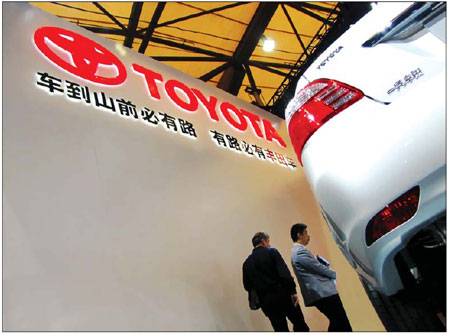
In June , the biggest Japanese carmaker Toyota Motor Corp sold 59,500 vehicles in China after selling only 38,500 in May .
Subscribe to:
Posts (Atom)