Article on Volvo and Geely published by Swedish magazine based on an interview held with Bill Russo at the annual conference of the World Steel Association.
Dagens industri
View more documents from Synergistics Limited.
U.S. Rep. John Dingell, a Dearborn Democrat who has battled on the behalf of American auto companies since joining Congress in 1955, said in a letter to Zhang Yesui, the People's Republic of China's ambassador to the U.S., that such a plan "may lead to and validate retaliatory action" against Chinese imports.
Last Thursday, the Wall Street Journal reported on a draft proposal coming out of China's Ministry of Industry and Information Technology for making the nation a leader in electric-vehicle production within 10 years.
It suggested that foreign automakers wanting to produce electric vehicles in China for its growing market could be forced to accept a minority stake in joint ventures with Chinese companies and required to share new electric-vehicle technology with them.
American automakers are already required to partner with Chinese companies to do business in that country, but some consultants -- like Bill Russo, who used to be part of Chrysler's operations in China and who spoke to American Public Media's radio show Marketplace last week -- doubt the Chinese government will follow through on anything that would cause foreign automakers to make their newest technology elsewhere.
Dingell, however, said it was "enormously troubling" that the world's largest nation would require automakers to hand over proprietary technology in exchange for market access and that the U.S. and the World Trade Organization need to be ready to fight back, especially at a time when concerns have been raised about China manipulating its currency to get a competitive advantage.
Contact TODD SPANGLER: 202-906-8203 or at tspangler@freepress.com.
Sept. 22 (Bloomberg) -- When Warren Buffett visits Chinese carmaker BYD Co. next week, he’ll find a company facing sliding sales and legal disputes with the government and Foxconn International Holdings Ltd.
Berkshire Hathaway Inc.’s $232 million investment in Shenzhen-based BYD was worth about $2.5 billion last year as the company became the fastest-growing Chinese carmaker. That stake is now valued at about $1.6 billion after BYD’s shares plunged 18 percent this year. Its sales fell 19 percent last month while rivals Dongfeng Motor Group Co., General Motors Co. and SAIC Motor Corp. gained at least 19 percent.
BYD chairman Wang Chuanfu also may not deliver electric cars to California this year as promised. The company’s share decline this year compares with a 0.6 percent increase in Hong Kong’s benchmark Hang Seng Index.
“No company can live up to the hype BYD’s received” after Buffett’s investment, said John Casesa, managing partner at New York-based Casesa & Co. “It would have to do everything absolutely perfectly to live up to the expectations of the market at the peak stock price, and no company does everything perfectly.”
Forecast Slashed
Buffett, 80, makes his first visit to BYD next week to inspect a plant in Changsha. He will be accompanied by Microsoft Corp. founder Bill Gates to promote philanthropy among wealthy Chinese.
The company posted a second-quarter profit of 717 million yuan ($107 million), less than the 962 million-yuan average estimate of four analysts surveyed by Bloomberg. At least nine analysts lowered stock ratings on BYD.
The company also slashed its 2010 sales outlook by 25 percent to 600,000 vehicles from 800,000 on Aug. 4. Paul Lin, a BYD spokesman, said last month’s weak sales to dealers stemmed from the company reducing its inventory of unsold cars.
BYD relied too much on the compact segment and set overoptimistic sales targets, said Bill Russo, a Beijing-based senior adviser at Booz & Co. The government also raised taxes on cars with small engines, partially reversing incentives that made BYD’s F3 sedan China’s best-selling car in 2009.
‘Hypercompetitive Market’
“They sold a lot of F3s last year, but at some point, you reach diminishing returns in a hypercompetitive market,” Russo said. “Overpromise based on your ambitions and under-deliver on your actual performance, eventually you get humbled.”
BYD surged 850 percent after Buffett’s investment and reached a record HK$88.40 on Oct. 23. It closed at $HK56.20 yesterday.
Buffett didn’t respond to a request for comment left with his assistant, Debbie Bosanek.
MidAmerican Energy Holdings Co., a unit of Berkshire Hathaway, holds 9.9 percent of BYD. The Chinese company was founded in 1995 and made lithium-ion batteries for handsets. Wang bought troubled Xi’an Tsinchuan Auto Co. in 2003.
The company will show a new electric bus during Buffett’s visit after introducing the M6 minivan and L3 coupe this summer.
“We plan to roll out new models in the second half,” Wang, 44, said in Hong Kong last month. “With them, we hope to gain a bigger market share and improve profitability.”
Government Investigation
Falling prices may further weaken profitability. At a BYD dealership on Shanghai’s Hunan Road, boards advertise cash discounts of up to 12,000 yuan ($1,787) and free gifts for the F3 sedan with a 70,800-yuan sticker price.
The company’s third-quarter earnings are “going to look ugly” because of weak sales, said Charles Guo, an analyst at JPMorgan Chase & Co. in Hong Kong. He expects company profit to recover in the fourth quarter as overall car buying picks up.
Two lawsuits also weigh on BYD
China’s Ministry of Land and Resources is investigating BYD over the illegal use of farmland it agreed to buy in Xi’an from a local economic development agency. The carmaker built factories even though 92 percent of the land they occupied was still zoned for agriculture, the ministry said July 15.
The government said it will decide by Sept. 30, the final day of Buffett’s visit, whether to punish the automaker. Lin wouldn’t discuss the potential implications.
Foxconn, the maker of Apple Inc. iPhones, accuses BYD of stealing trade secrets. That helped BYD, China’s biggest rechargeable-battery maker, double revenue from its handset business from 2005 through 2007, Foxconn said in court documents.
EV Struggles
BYD countersued, claiming that Foxconn gathered false evidence and conspired to injure its business.
Terry Gou, chairman of Foxconn Technology Group, criticized Buffett’s purchase of BYD shares in a Bloomberg Businessweek interview.
“He doesn’t know the technology,” Gou said, referring to the batteries used in electric vehicles and plug-in hybrids. “He just used his name to speculate on the stock.”
Analysts also are re-evaluating BYD’s electric-vehicle strategy. The carmaker likely won’t deliver its E6 model to the U.S. before the second half of 2011, said Scott Laprise, a Beijing-based analyst at CLSA Asia Pacific.
Lin said BYD still plans to ship the cars to California this year.
BYD last year delivered 48 of its F3DM plug-in hybrid cars selling for 149,800 yuan each. The company declined to give 2010 sales figures.
Still, BYD’s strength in batteries may pay off for investors, Casesa said. China, the world’s biggest polluter, offers subsidies for cars powered by electricity.
China is paying as much as 50,000 yuan toward the purchase of plug-in hybrid models and up to 60,000 yuan for vehicles running only on batteries in Shanghai, Changchun, Shenzhen, Hangzhou and Hefei.
“They’ve been in the batteries business a lot longer than car companies,” Casesa said. “That’s why most industry observers are reluctant to dismiss the company despite a lot of skepticism about their claims.”
--Liza Lin. With assistance from Andrew Frye in New York and Tim Culpan in Taipei. Editors: Ian Rowley, Michael Tighe.
To contact Bloomberg News staff for this story: Liza Lin in Shanghai at Llin15@bloomberg.net
To contact the editor responsible for this story: Kae Inoue at kinoue@bloomberg.net

Hu Maoyuan, chairman of Shanghai Automotive Industry Corp. (SAIC).
SAIC Motor Corp. said it may invest in the initial public offering of partner General Motors Co., cementing ties between the biggest U.S. and Chinese automakers.
China’s largest carmaker will consider investing in GM if “conditions are favorable,” Chairman Hu Maoyuan said in Shanghai yesterday. The company hasn’t yet made a decision whether to make the investment and is waiting for the details of the share sale, he said yesterday.
The automakers, which have made cars together in China for more than a decade, said in December they would also sell low- cost vehicles in India. GM filed for an IPO in August as the U.S. government seeks to pare the 61 percent stake it gained in the company through its bankruptcy and $50 billion taxpayer bailout last year.
“GM is our important strategic partner,” Hu said. “We are not clear about the details of its IPO. We will make the right decision once we know details.”
SAIC’s Shanghai-listed shares rose as much as 3.4 percent today to 17.52 yuan and changed hands for 17.41 yuan as of 10:51 a.m. The benchmark Shanghai Composite Index gained 0.1 percent.
The joint venture partners are developing a new engine and transmission system together, have launched a new car brand Baojun in the Chinese market, and have formed an alliance to sell low-cost cars in India.
‘Perfect Sense’
“Politics and government relationship aside, it makes perfect sense,” said Bill Russo, Beijing-based senior adviser at Booz & Co. “Why can’t there be a China-America alliance? Fear of China is the only reason.”
GM’s initial public offering will be open to overseas investors, the U.S. Treasury said in a statement on its website. Retail and institutional investors will be offered shares, and the Treasury “will not involve itself in decisions regarding allocation of shares to specific buyers,” the department said.
GM “cannot comment on speculation surrounding a public offering,” Shanghai-based spokesman Mike Albano said in an e-mailed statement on Sept. 18.
China Ventures
The Detroit-based automaker, whose partners in China also include Wuling Motors Co. and China FAW Group Corp., sold 1.2 million vehicles in the nation during the six months ended June 30, according to a company filing related to the IPO.
Combined income from the joint ventures with SAIC and Wuling rose to $734 million in the first six months of the year from $298 million a year earlier.
“It’s not a bad idea for GM and SAIC to further their ties if it means getting GM better ingrained in the Chinese market,” Aaron Bragman, an analyst with IHS Automotive in Northville, Michigan, said in a telephone interview. “That’s where the money is going to be made for the industry.”
China’s wholesale deliveries of passenger cars increased 18.7 percent to 1.02 million units in August, compared with 13.6 percent growth in July, the China Association of Automobile Manufacturers said in an e-mailed statement on Sept. 9.
Sales in markets such as China and India are helping offset slumping demand in the U.S. and Europe. China, which overtook the U.S. as the world’s largest auto market last year, may sell 16 million vehicles this year, the association said last month, boosting its forecast from a previous estimate of 15 million.
‘In Great Shape’
GM, whose sales in China rose 19.2 percent from a year earlier to 181,625 vehicles last month, is counting on emerging markets including China to bolster profit as it prepares for what may be the second-largest initial public offering in U.S. history.
The carmaker is “in great shape” to hold an offering, United Auto Workers President Bob Kingsaid in a Bloomberg Television interview.
“It will actually help them sell more product when they’ve done the IPO,” King said. “I think the American public will see that they’re a strong and healthy company.”
GM, China’s largest foreign carmaker, makes vehicles including Buick Excelle and Regal cars as well as Chevrolet Lova compacts with its Chinese joint-venture partner SAIC Motor Co. It also makes Sunshine minivans at SAIC-GM-Wuling Automotive Co., a venture with SAIC in which it owns 34 percent.
The two partners plan to introduce the Chevrolet Volt in China next year, the U.S. carmaker said in a statement on July 27, as part of a plan to sell “several” hybrid and electric vehicles in the coming months.
In December, GM and SAIC signed an agreement to invest $650 million to form an equally-controlled venture to sell cars in India. The American automaker plans to spend $250 million in introducing five SAIC models in Asia’s second most populous nation, Karl Slym, president of GM’s Indian unit said in July.
--Liza Lin, Helen Yuan in Shanghai and Suzanne O’Halloran in New York. Editors: Kevin Orland, Kae Inoue
To contact the reporters on this story: Liza Lin in Shanghai at llin15@bloomberg.net.
Click here to view the original article on Bloomberg.com
The Chinese auto market makes a habit of defying even the most optimistic of predictions.
But when a Chinese government official warned recently that head-long investment by the car industry would leave China with a big overcapacity problem by 2015 – when capacity reaches 31m vehicles per year – he touched off a fierce debate over whether the domestic market can absorb all those cars or whether some will be dumped cheaply on world markets.
Serious overcapacity will lead to negative market competitiveness, a loss in enterprise efficiency, factory stoppages and other problems,” Chen Bin, a top official at the National Development and Reform Commission (NDRC), China’s economic planning agency, said recently. A Chinese car industry producing 31m vehicles would be nearly twice the size of the current domestic market – estimated at 16m-17m this year – and well over double the current US market.
Charlene Barshefsky, former US trade representative, predicts a new trade war in the making. “The glut will be destined for export and that will increase trade tensions,” she told a car industry conference in the Chinese city of Chengdu last week.
But Chinese carmakers dispute the very notion of overcapacity. “We believe the domestic market demand will reach 25m units [by 2015] and therefore annual capacity of 30m should not be considered too much,” the China Association of Automobile Manufacturers said.
The problem for many of the leading carmakers at the moment is not excess capacity, but lack of it, says Mike Dunne of Dunne & Co, an Asian car consultancy. “The top 10 carmakers, with 90 per cent of the market, are short of capacity,” he says.
Ivo Naumann, of motor industry advisers AlixPartners in Shanghai, says the overcapacity numbers may be exaggerated, since they are based on often inflated projections from car companies themselves. And even if all that capacity eventually materialises, it is far from clear that the market will be too weak to absorb it.
“The NDRC warned about overcapacity in 2006, but they were proved wrong,” says Yang Jian, editor of Automotive News China.
“The capacity problem will be solved over time,” says Bill Russo of Synergistics, a Beijing auto consultancy, and former head of Chrysler in China. He says the problem is not total capacity, but which companies are building the new factories: Chinese car companies are adding capacity much more quickly than their stronger foreign rivals.
“Local brands are adding capacity in the belief that they can capture half the market by 2015,” says Mr Russo, up from 30 per cent now. “However, this is proving quite difficult since Chinese consumers are typically not loyal to Chinese brands,” he adds.
The Chinese government is not just worried about excess capacity. It has also struggled for years to force the consolidation of the highly fragmented car market, which Mr Russo says comprises 120 vehicle manufacturers.
Beijing has called for the formation of four large state-owned national “champions” producing 2m vehicles per year each, and four more companies producing 1m each.
But in such a strong car market – Chinese sales rose 46 per cent last year – there is little incentive to consolidate. “It’s difficult to get any kind of consolidation in the face of tremendous growth in this market,” says Mr Russo.

Drivers and passengers step out of their vehicle while stuck in traffic along the Airport Expressway in Beijing. (Frederic J. Brown/AFP/Getty Images)
BILL RADKE: The Wall Street Journal today reports China could start playing hardball with foreign automakers. The paper says the government is thinking about plans to force those carmakers to share cutting-edge electric vehicle technology if they want to continue manufacturing in China. But some auto industry experts say they don't believe it.
Marketplace's China bureau chief Rob Schmitz reports.
ROB SCHMITZ: The report quotes unnamed auto executives. They say China's government wants to force foreign automakers into joint ventures with Chinese companies if those foreign companies want to make electric vehicles in China. Industry insiders willing to talk on the record, though, don't buy it.
BILL RUSSO: It would be foolhardy to implement a policy that has restrictions on foreign investment.
Bill Russo helped run Chrysler's operations in China and now heads Synergistics, Ltd., a consulting firm in Beijing. He says even though China has the world's top commercial market for electric vehicles, it's way behind the West in terms of technology. He says China knows this kind of policy would cause foreign automakers to pack up and manufacture their most innovative technology elsewhere.
RUSSO: The reality is this is a global industry, this is a technological frontier that requires collaboration between domestic and foreign companies.
Russo -- and other industry analysts -- say circulating a draft proposal is a typical way China's government gauges industry opinion. He says it oftentimes has little to do with what's enacted.
In Shanghai, I'm Rob Schmitz for Marketplace.
[导读]首届全球汽车论坛于2010年9月16-17日在成都召开,腾讯汽车作为官方三大合作伙伴,在论坛现场进行全程跟踪式报道,并为您带来重磅嘉宾访谈。腾讯汽车独家专访了博斯公司高级专家罗威。
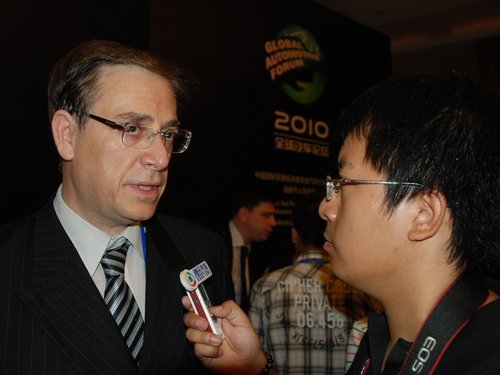
专访博斯公司高级专家 罗威
[腾讯汽车9月16日 成都报道] 首届全球汽车论坛于2010年9月16-17日在中国成都召开,腾讯汽车作为官方三大合作伙伴,在论坛现场进行全程跟踪式报道,并为您带来重磅嘉宾访谈。在16日论坛现场,腾讯汽车独家专访了博斯公司高级专家罗威。以下是采访实录。
腾讯汽车:您认为中国在入世后,对汽车产业有什么好处吗?
罗威:当然是有好处的。入世以来,中国的汽车产业提供了大量的就业岗位。
腾讯汽车:在中国众多的汽车产商中,多数厂商品牌发展的很快。您觉得呢?
罗威:汽车品牌的形象的是日积月累的,正如一位业内人士所说。随着发展时间的延续,它们的品牌认知与国际厂家比起来,差距逐渐变小。但同样也会面临诸如产品同质化等方面的挑战。因此各厂商应致力于建立自己的研发体系,研发适合不同市场的技术。但随着其发展时间的延续,他们会越来越有经验,因为汽车行业本来就是一个需要多年积累的领域。如何迎接挑战、做好相关工作,对于新兴技术领域,更是如此。所以可能还要再过20年,经历一两个发展周期,可能中国的汽车厂商会做得更好。
腾讯汽车:您刚才提到,品牌的建立依赖于对产品质量和技术的重视。中国的厂商只用了数十年就走过了你们用百年走过的发展道路,对于类似于狂飙式的发展速度,对您的中国同行,您有什么建议或忠告呢?
罗威:就像之前说到的一样,我认为中国公司应重点发展那些和其品牌相关的领域,而不应贪大求全,要做产品的创新者和技术的引领者,要专注于自己的领域,积累经验。并且还应该将品牌含义清晰地传达给消费者,和别的品牌区分开来。

专访博斯公司高级专家 罗威
腾讯汽车:我们知道中国的汽车产商,像吉利和奇瑞,在品牌建设上花了很多功夫,像它们就将其产品划分成四个独立的品牌,这被视作是一种品牌保护战略。而与此不同的是。美国的厂商却都纷纷出售其品牌,对此你有何看法?
罗威:要创建一个品牌不是那么容易的。中国厂商其实应研究下如何才能挖掘品牌内在意义和维护其形象。如果上面的这些做法都是专注于一个品牌的话,这就很好。但如果要同时维护四五个品牌的话,那就太难了。所以我觉得要创建一个品牌的话会很容易,但要持续不断的进行品牌的定位并将其传达给消费者,就太难了,尤其是对那些没有经验的公司。
版权声明:本文系腾讯汽车独家稿件,版权为腾讯汽车所有。欢迎转载,请务必注明出处(腾讯汽车)及作者,否则必将追究法律责任。

